Shorts

This lecture emphasizes the immense reward for exercising patience with difficult relatives. It asserts that enduring their misbehavior with forbearance will yield double the reward. The lecture clarifies that the good deeds earned through patience will be transferred to those who wronged you, while their sins will be deducted from your account on the Day of Judgment. Therefore, one should not abandon fulfilling their familial obligations and should actively resist the urge to cut ties, even in the face of adversity.

46

This lecture discusses the importance of *khushu* (humility and devotion in prayer) and *tazkiya-e-nafs* (self-purification). It emphasizes that true worship goes beyond merely performing rituals; it requires a sincere connection with the Divine and a constant striving for self-improvement. The speaker highlights that valuable time should not be wasted on frivolous activities but dedicated to personal growth and purification. The concept of *zakat* is explained not as financial charity in its later legal form, but as a continuous process of self-assessment and removing inner flaws. The focus is on consistently striving for moral and spiritual cleansing.
71

This lecture dissects the phenomenon of self-deception and the inescapable truth of one's own character. It asserts that while individuals may silence external opposition, they cannot escape the internal reckoning of their conscience. The lecture emphasizes that the self-reproaching soul (nafs-e-lawwama) possesses an inherent awareness of an individual's true nature and limitations. Despite rationalizations, excuses, or justifications, the conscience persistently reveals one's authentic self, stripping away facades and exposing underlying realities. This internal assessment remains constant regardless of external presentations.
35

This lecture discusses a crucial inner assessment. One side of a metaphorical scale holds love for eight worldly things: father, son, siblings, spouse, relatives, wealth, skills, and home. The other side holds love for God, the Prophet, and striving in His path. True faith requires that the latter outweigh the former. Until this balance is achieved, one remains susceptible to worldly desires and divine guidance is withheld. Every individual must establish this internal scale to evaluate their spiritual state and prioritize devotion over material attachments. It emphasizes the importance of sincere faith and prioritizing spiritual values to attain divine guidance and success.
46
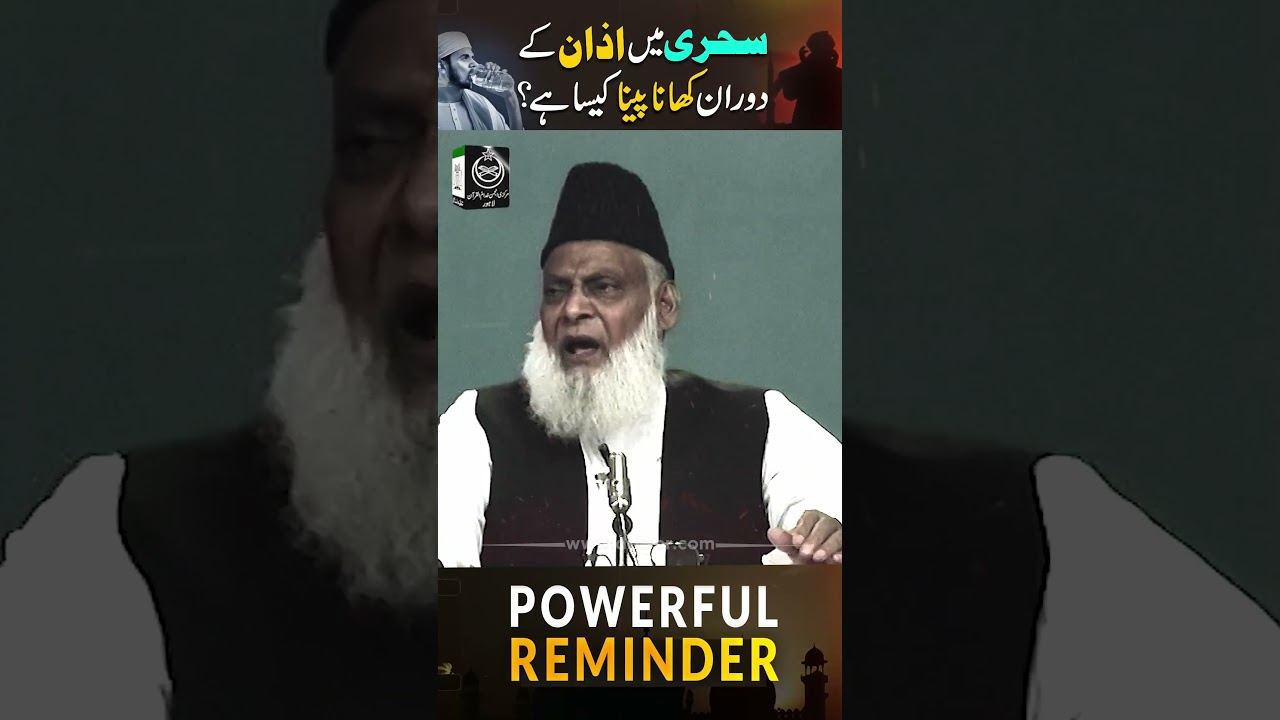
The lecture discusses the Prophet Muhammad's guidance regarding the timing of Suhoor (pre-dawn meal) and Iftar (breaking of the fast). He discouraged excessive caution and rigidity in observing the timings, emphasizing ease and flexibility. The Prophet allowed individuals to finish their meals even after the call to prayer for Fajr, promoting a balanced approach to religious observance. The principle of prioritizing ease over difficulty, as stated in the verse concerning permissible limits for fasting until the white thread distinguishes itself from the black, is highlighted. This approach promotes a spiritual practice that is accessible and sustainable.
38

This lecture explores the interplay between divine decree (taqdeer) and the efficacy of prayer (dua). It clarifies that while Allah has knowledge of all outcomes, sincere supplication can influence events within the bounds of His will. The discussion addresses whether good deeds and prayers can increase blessings or mitigate difficulties ordained by Allah. It also explains the concepts of fixed and suspended decree, and how human actions, both righteous and otherwise, impact one's sustenance and blessings. Finally, it highlights that increased blessings can also manifest as greater barakah (divine blessing) within existing provisions, stemming from contentment and divine grace.
27
