Calção

Dr. Israr Ahmad discusses the concept of a 'State of Medina' and its moral foundations, criticizing the hypocrisy of those who invoke its principles while failing to embody its ethical standards. He emphasizes the importance of upholding justice, promoting good, and preventing evil, and warns against inconsistency between professed ideals and actual conduct. He stresses the need for genuine piety and righteousness in all aspects of life, particularly within political spheres. He further clarifies that offering constructive advice to those in power is a continuous responsibility, driven by a desire for societal betterment.

61
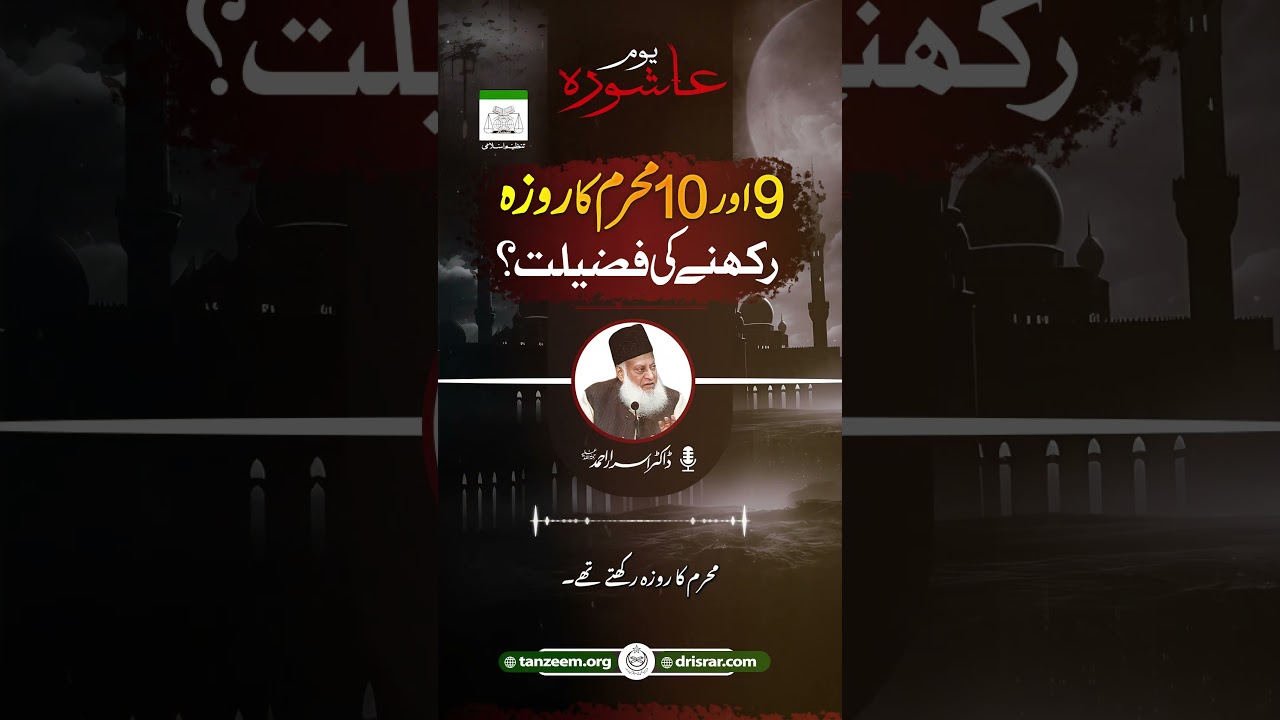
The observance of fasting on the 9th and 10th of Muharram is a recommended practice. It originated from the Prophet Muhammad’s desire to distinguish the Muslims from the Jewish community of Medina, who fasted on the 10th of Muharram commemorating their liberation from Pharaoh. The Prophet, acknowledging a stronger connection to Moses, instructed his companions to fast for two days – the 9th and 10th – instead of one. While not obligatory, this practice holds significance as a voluntary act of worship and a demonstration of the Muslim community's unique identity.
60

The essence of worship lies in the interplay between love and obedience. Obedience represents the visible form of worship, while love is its underlying spirit. True worship stems from a genuine affection for the Divine, transforming acts of obedience into meaningful devotion. Without love, obedience becomes a mere formality, potentially driven by compulsion, pretense, or self-interest. The body exists because of the soul; similarly, worship exists through the spirit of love. Love animates obedience, giving it life and sincerity. Without this animating force, obedience remains an empty shell.
54

This lecture emphasizes that true faith necessitates action, striving, and sacrifice. It refutes the misconception that mere belief alone guarantees salvation or progress. The speaker argues that a life devoid of effort, dedication, and selfless contribution is ultimately futile. Genuine faith, coupled with righteous deeds, mutual encouragement towards truth, and patience in adversity, are essential for a meaningful existence and achieving success in this life and the hereafter. It stresses the imperative of continuous effort and commitment as fundamental requirements for spiritual and worldly advancement, rejecting the notion of effortless attainment.
71

Dr. Israr Ahmad discusses the pervasive influence of immoral culture and its detrimental effects on society. He highlights how obscenity is being normalized and propagated through media, infiltrating even private homes. The lecture emphasizes the urgent need to recognize and address this growing crisis, as it threatens the moral fabric of communities and families. Dr. Ahmad critiques the deceptive branding of immorality as something acceptable, and warns against its insidious spread.
70

The Prophet Muhammad (peace be upon him) serves as the best example for those who believe in God and the Day of Judgement, and who consistently remember God. The Quran provides guidance for all, but only those who are pious and fulfill specific conditions—faith in God and the afterlife, and constant remembrance of God—will truly benefit. This lecture highlights the Prophet’s life as a complete argument for humanity. The establishment of Islam's social justice system was achieved through persistent effort, hardship, sacrifice, patience, perseverance, and resilience, not through miracles or divine comforts. The example of the Battle of Tabuk demonstrates the dedication of early Muslims, even sharing meager rations to support one another. This is the essence of the Prophet’s legacy.
78
