Şort
True well-wishing stems from sincerity and a genuine desire for another’s betterment. It requires approaching someone lost in ignorance or error with compassion, not arrogance or intellectual superiority. Effective guidance involves embodying the principles you preach; hypocrisy renders your message ineffective. Genuine concern means prioritizing the other person’s well-being and acting with consistency between words and deeds. Those who command good but fail to practice it themselves contradict their own message and discredit their efforts. True guidance requires internalizing the principles you advocate.

66

This lecture clarifies that the ultimate abode, the Hereafter, is reserved for those who abstain from seeking power, dominance, or causing corruption on Earth. It emphasizes that this eternal reward is specifically for the righteous—those who prioritize piety and abstain from worldly ambitions. The lecture highlights the promise of lasting peace, prosperity, and fulfillment in the Hereafter for those who live a life of devotion and righteousness, and that ultimate success and well-being are reserved for the God-conscious.
58

This narrative recounts an instance where the Prophet Muhammad (PBUH) requested to use an camel owned by Hazrat Abu Bakr. Hazrat Abu Bakr, overjoyed, offered the camel as a gift, having prepared it specifically for the journey. The Prophet insisted on paying for it. Hazrat Abu Bakr, moved to tears, expressed that his life and possessions were already dedicated to the Prophet, and offering the camel without payment was a matter of honor. This demonstrates the Prophet’s integrity and Hazrat Abu Bakr’s profound devotion and generosity.
49
The text discusses the true nature of faith, emphasizing that genuine belief requires both verbal affirmation and sincere conviction of the heart. It contrasts this with the hypocrisy of those who profess faith but lack inner belief. The passage highlights the importance of believing in God, His angels, His books, His messengers, and the Day of Judgement. Rejecting any of these constitutes profound error and leads to severe spiritual deviation. True faith encompasses complete acceptance of divine guidance and the consequences of belief or disbelief.
54

The speaker describes a massive gathering of people traveling towards a destination, likely a religious event, emphasizing the unified message of monotheism (Tauheed) expressed by the participants. The continuous flow of vehicles and the sheer number of attendees highlight the scale of the event and the profound impact of the shared belief. The speaker recounts witnessing this procession firsthand, noting the unbroken line of lights stretching for miles.
50
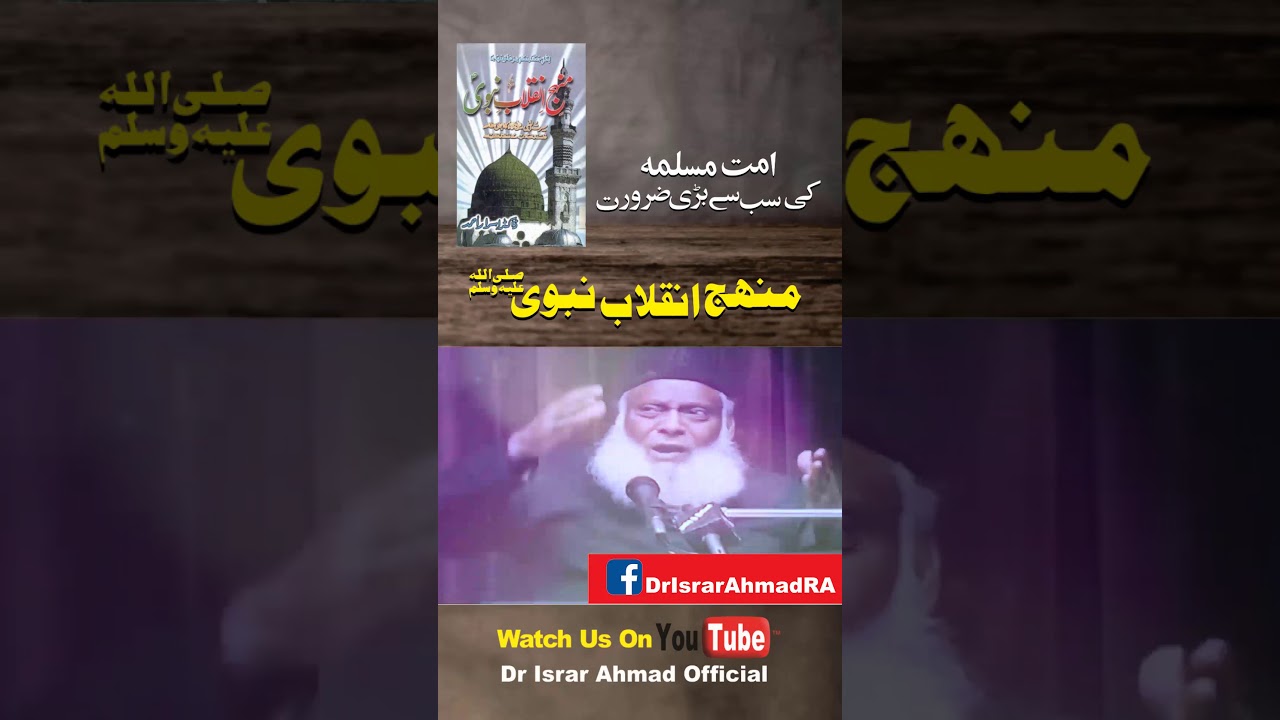
Dr. Israr Ahmad discusses the reasons behind the lack of fervor within the Muslim community, connecting it to a lack of understanding of the prophetic revolution. He argues that the current state of disillusionment and self-destructive behaviors – exemplified by acts of desperation and misguided aggression – stem from a loss of direction and a failure to comprehend the principles of the Prophet Muhammad’s revolutionary message. He emphasizes that without grasping the essence of this revolution, individuals will remain lost and misdirected.
379
