Calção
Dr. Israr Ahmad discusses the creation of Jinn and Adam, highlighting their distinct compositions and the source of their creation. He explains that Jinn were created from smokeless fire, while Adam was created from clay. This difference in origin accounts for the superiority of Adam, as he was imbued with the divine spirit (Ruh Muhammadi) that Jinn lacked. The lecture emphasizes that Adam’s creation involved a spiritual dimension absent in the Jinn, making him a more complete and worthy creation. The speaker argues that the Jinn's inferior nature stems from this lack of spiritual essence.

61

Dr. Israr Ahmad discusses the concept of a 'State of Medina' and its moral foundations, criticizing the hypocrisy of those who invoke its principles while failing to embody its ethical standards. He emphasizes the importance of upholding justice, promoting good, and preventing evil, and warns against inconsistency between professed ideals and actual conduct. He stresses the need for genuine piety and righteousness in all aspects of life, particularly within political spheres. He further clarifies that offering constructive advice to those in power is a continuous responsibility, driven by a desire for societal betterment.
61
Maintaining balance between the oneness of God and love for the Prophet is crucial. Obedience to God and the Prophet are equal in importance, but one follows God's commands while the other emulates the Prophet’s example. Following the Prophet is obligatory, achieved through action, not just claims. Any practice that claims to follow the Prophet without enacting it is fraudulent and creates a distinction between truth and falsehood. True adherence to the Prophet is demonstrated through practical application of his teachings.
69
This lecture details the stages of the Day of Judgement according to Islamic eschatology. It describes the first trumpet blast causing widespread destruction and loss of consciousness, impacting all of creation in the heavens and on earth, except those whom Allah wills. The second blast initiates the resurrection, bringing all to a standing position. The third blast signifies the final judgement. The lecture further explains the descent of Allah, the splitting of the sky, the descent of angels, and the presentation of the Book of Records, prophets, and witnesses on that day. The lecture underscores the inevitability and gravity of the Day of Judgement and encourages contemplation of the afterlife.
61
This lecture discusses the true essence of *a’etiqaaf* (seclusion in a mosque for worship), emphasizing it as the peak of devotion during Ramadan. The speaker clarifies that *a’etiqaaf* is not a social gathering or a time for frivolous activities like card games. It's a period for intense personal connection with God through solitude, contemplation, Quran recitation, remembrance of God, and voluntary prayers. The lecture stresses that the purpose of *a’etiqaaf* is to attain closeness to God, not to socialize with people, and highlights its significance as the culmination of Ramadan's spiritual journey.
49
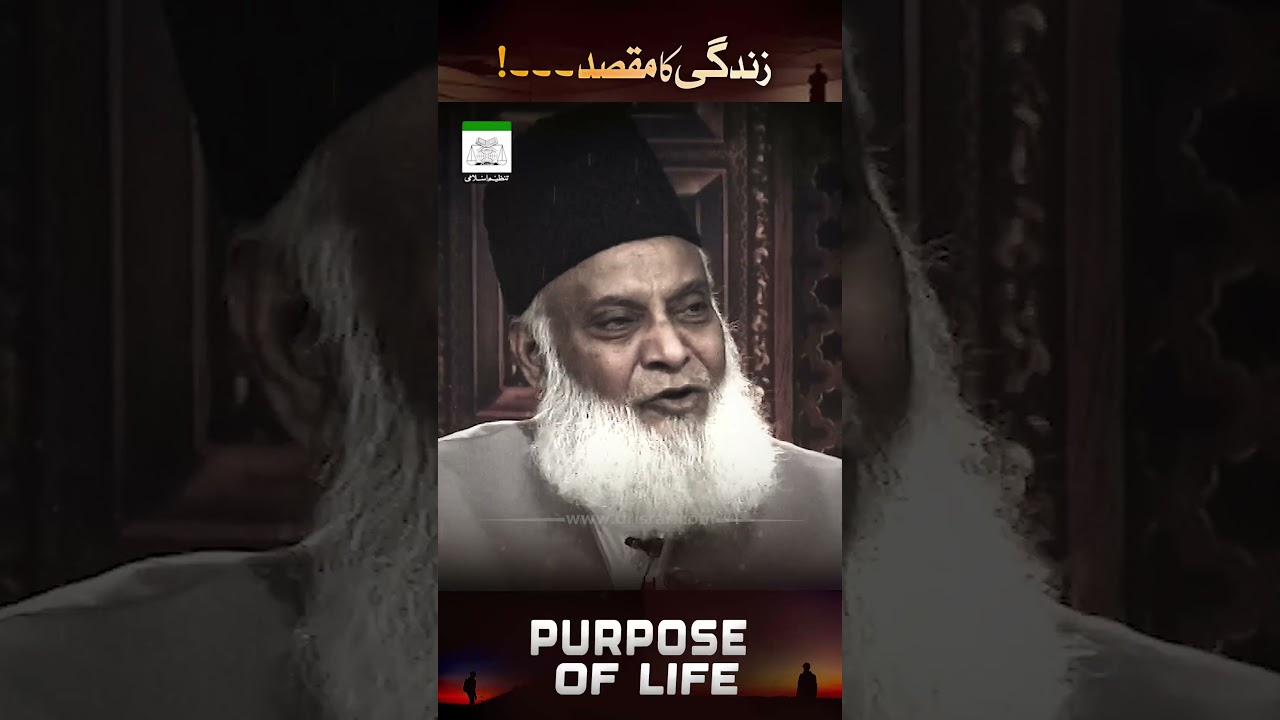
Every conscious human being has a purpose, an ideal, or an inspiration in life. They strive to achieve this ideal through effort and perseverance. A person without purpose is akin to an animal, living solely on instinct and fulfilling basic needs like eating and reproduction. Animals exist based on instinct, lacking a higher purpose. Such a life is considered base. The Quran emphasizes that a life devoid of purpose is animalistic. True humanity lies in having a defined goal and striving towards it.
97
