Corti
This lecture discusses the necessity of establishing a system of leadership based on fundamental Islamic principles, particularly in the context of modern times. The speaker argues that while the prophetic era has ended, the need for guidance and just governance remains. He emphasizes the importance of adhering to core Islamic tenets while adapting detailed structures to the demands of the present age. The lecture stresses the need for a leader to resolve disputes and maintain unity within the community, drawing parallels to the practice of appointing an ameer during journeys. The speaker identifies as a fundamentalist, meaning one who upholds Islamic principles, while acknowledging room for differing interpretations in detailed matters.

47
The speaker reflects on a lifetime of acquiring knowledge – philosophy, Eastern and Western learning – and realizes its inadequacy without divine connection. He describes this knowledge as a fruitless palm tree, devoid of benefit. He expresses a desire to move beyond intellectual understanding to experience divine madness, passion, and a consuming love for God, seeking a spiritual awakening after resolving life’s complexities.
57
The lecture addresses the permissibility of naming someone 'Akbar'. It clarifies that the name 'Akbar' in itself does not equate to the name of God, as 'Allah Akbar' is a specific phrase denoting God’s greatness. The name 'Akbar' becomes associated with God only when prefixed with 'Al-' (the definite article). Therefore, using 'Akbar' as a personal name is permissible, as it does not inherently invoke the divine name without the necessary prefix.
77
Partial obedience is ultimately disobedience. True faith demands complete submission to divine commands. Selective acceptance of religious tenets renders all obedience void. This lecture details the severe consequences outlined in Surah Baqarah, verse 85, for those who pick and choose which aspects of faith to follow. Such individuals face humiliation in this world and intensified punishment on the Day of Judgement. The core message emphasizes that the veto power resides within one's own desires, and yielding to them when it comes to divine commands is unacceptable. Complete and sincere obedience is essential for spiritual well-being and salvation.
58
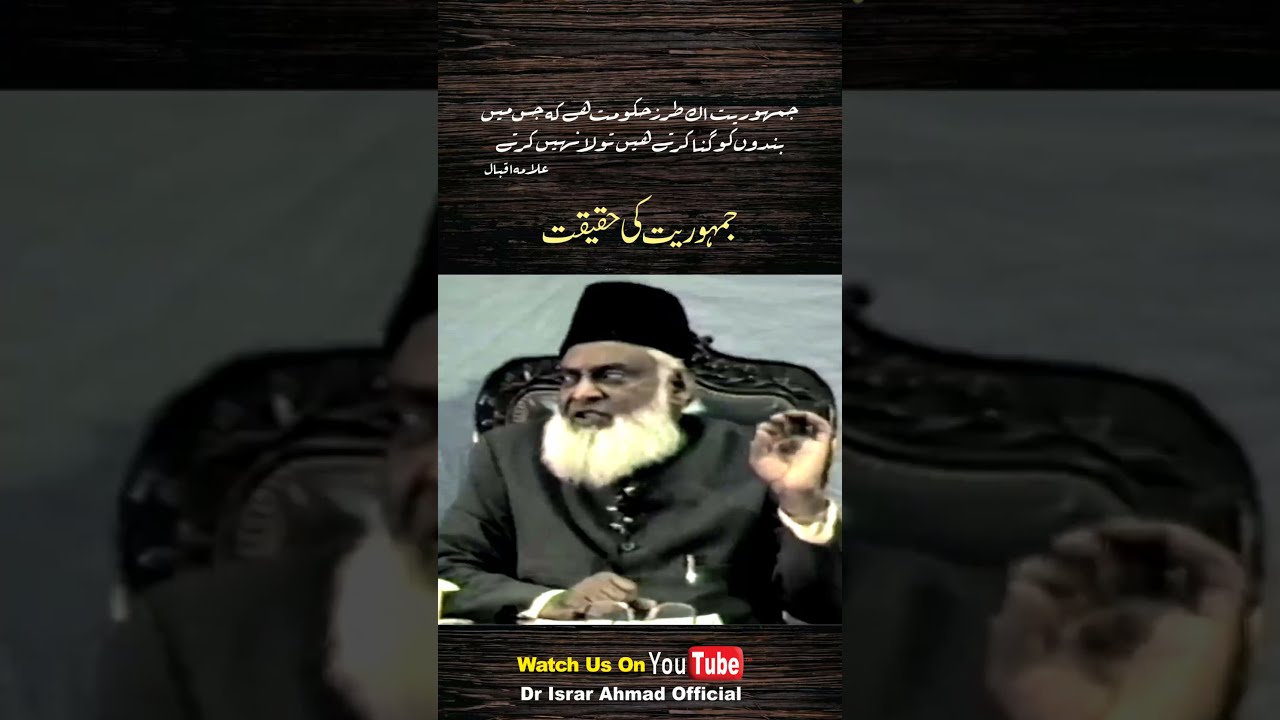
This lecture analyzes the concept of democracy, arguing that current systems, particularly in America, are not true representations of popular will but rather disguised forms of dictatorship controlled by capital. The speaker contends that true democracy can only exist when economic justice is established, allowing citizens to make informed decisions free from the influence of wealth. The current electoral process is likened to a mere formality, a ‘slip’ of paper in the hands of the common man, manipulated by powerful financial interests. The lecture emphasizes that genuine democracy requires equitable economic opportunities for all citizens, empowering them to exercise their political agency meaningfully.
56
True goodness isn't merely external ritual; it’s an internal transformation affecting the entire being. The essence of worship, like prayer, lies not in its technicalities, but in achieving a spiritual presence with God. Genuine prayer evokes a heartfelt connection, a sense of joy, and a direct communion with the Divine. The experience should be one of complete surrender and humility before God. Without this spiritual depth, the act remains incomplete.
37
