Corti
This lecture explores the profound meaning of ‘La Ilaha Illallah’ (There is no god but Allah) and its connection to genuine faith. It clarifies that merely reciting Arabic phrases is insufficient; true belief originates from a deep, internal conviction. The speaker emphasizes that imitating ancestral practices without understanding is a form of superficiality. Real faith, the lecture asserts, is a personal affirmation arising from the heart, encompassing belief in Allah, the Messenger, the Quran, Gabriel, and the Day of Judgement. This internal validation is the foundation of genuine Iman.

84
Dr. Israr Ahmad discusses the comprehensive nature of Prophet Muhammad’s personality, highlighting his multifaceted roles as a ruler, leader, judge, husband, father, and spiritual guide. He contrasts this with the limitations of modern religious leaders who often struggle to fulfill even basic duties like leading five daily prayers consistently. The lecture emphasizes that the Prophet Muhammad embodied all these roles flawlessly, serving as a complete example for believers. The speaker points out a disconnect in modern religious practice, where individuals dedicated to self-purification often avoid leading congregational prayers.
54
This lecture discusses the true essence of *a’etiqaaf* (seclusion in a mosque for worship), emphasizing it as the peak of devotion during Ramadan. The speaker clarifies that *a’etiqaaf* is not a social gathering or a time for frivolous activities like card games. It's a period for intense personal connection with God through solitude, contemplation, Quran recitation, remembrance of God, and voluntary prayers. The lecture stresses that the purpose of *a’etiqaaf* is to attain closeness to God, not to socialize with people, and highlights its significance as the culmination of Ramadan's spiritual journey.
49

Human life is defined by struggle and hardship, as ordained by creation. Individuals face varying degrees of mental and physical exertion, with disparities in access to basic necessities like food. This often leads to health issues and anxieties about the future. The cycle of life, bound by limitations and sorrow, prompts the question of finding liberation from suffering before death. This universal human condition highlights the inherent challenges and search for meaning within existence.
61
Dr. Israr Ahmad discusses the stark contrast between the beauty of the Quran and the current state of the Muslim community. He highlights the internal contradictions that hinder Islam’s appeal and advocates for reclaiming lost members of the Muslim *ummah* before attempting to proselytize others. He emphasizes the need for self-correction and internal reform, arguing that a focus on reviving the faith within the community is paramount. The lecture questions whether the current portrayal of Muslims attracts people to Islam or repels them, and stresses the importance of addressing internal issues before outward propagation.
59
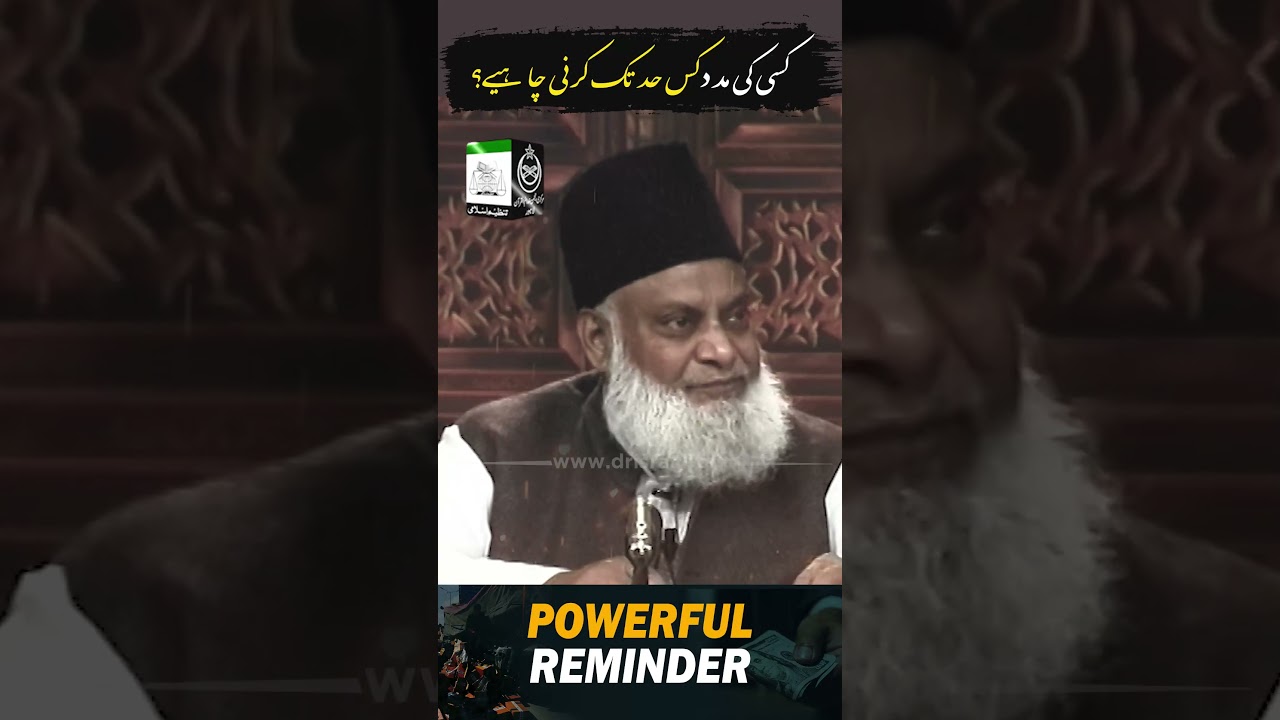
This lecture discusses the Islamic perspective on charitable giving and the rights of heirs. A companion of the Prophet Muhammad (peace be upon him) inquired about donating all his wealth for the sake of Allah. The Prophet advised against leaving heirs destitute, emphasizing their rightful share. The companion then proposed donating half, then a third, with the Prophet accepting the one-third contribution as appropriate. This highlights a balanced approach to charity, respecting both the act of giving and the welfare of one’s family.
64
