Шорты

This lecture details the events leading up to the creation of Pakistan. It highlights Jinnah’s initial stance of a ten-year unified India with three zones, the opposition from Gandhi who believed Pakistan’s formation depended solely on his consent, and the British government’s animosity towards Italy. The lecture also recounts Maulana Hussain Ahmed Madani’s prediction, made during Ramadan 1946, that the decision for Pakistan's establishment had been finalized within the Majlis-e-A'la. It emphasizes the historical context and key figures involved in the Pakistan Movement.

65

Goodness is fundamentally linked to faith, not merely action. True goodness originates from an internal state of belief. Every act has both an external manifestation and an internal motivation. The core of a good deed lies in the intention behind it—the desire to please God and attain His blessings. Faith fosters both positive motivation to do good and negative motivation to avoid evil. Love for God and the fear of His punishment drive righteous behavior. Belief in the afterlife—heaven and hell—further strengthens these motivations, prompting individuals to seek reward and avoid condemnation. Thus, faith is the driving force behind genuine goodness and moral conduct.
55

This lecture elaborates on Surah Al-Asr, emphasizing that humanity is in loss except for those who believe, perform righteous deeds, encourage truthfulness, and practice patience. It details the conditions for escaping this universal loss, highlighting the importance of faith, action, and moral character. The surah serves as a timeless reminder of accountability and the path to success in this life and the hereafter. Dr. Israr Ahmad meticulously analyzes each verse, providing insightful commentary on its meaning and application to contemporary life. The discussion focuses on how to achieve a balanced life grounded in faith and good deeds, and the consequences of neglecting these principles. It underscores the need for individual and collective responsibility in upholding truth and practicing patience in the face of adversity.
55

During the Hijra, when the Prophet Muhammad (peace be upon him) and Abu Bakr (may Allah be pleased with him) were in the cave of Thawr, they feared discovery. Abu Bakr expressed concern that even a glance inside would reveal them. The Prophet reassured him, reminding him of God’s support. Consequently, Allah sent down tranquility upon them and reinforced them with unseen forces. This event resulted in the subjugation of the disbelievers and the ultimate triumph of Islam throughout the Arabian Peninsula. God’s word is supreme, and He is the Most Powerful, the Most Wise.
64

This lecture explores the profound meaning of ‘La Ilaha Illallah’ (There is no god but Allah) and its connection to genuine faith. It clarifies that merely reciting Arabic phrases is insufficient; true belief originates from a deep, internal conviction. The speaker emphasizes that imitating ancestral practices without understanding is a form of superficiality. Real faith, the lecture asserts, is a personal affirmation arising from the heart, encompassing belief in Allah, the Messenger, the Quran, Gabriel, and the Day of Judgement. This internal validation is the foundation of genuine Iman.
84
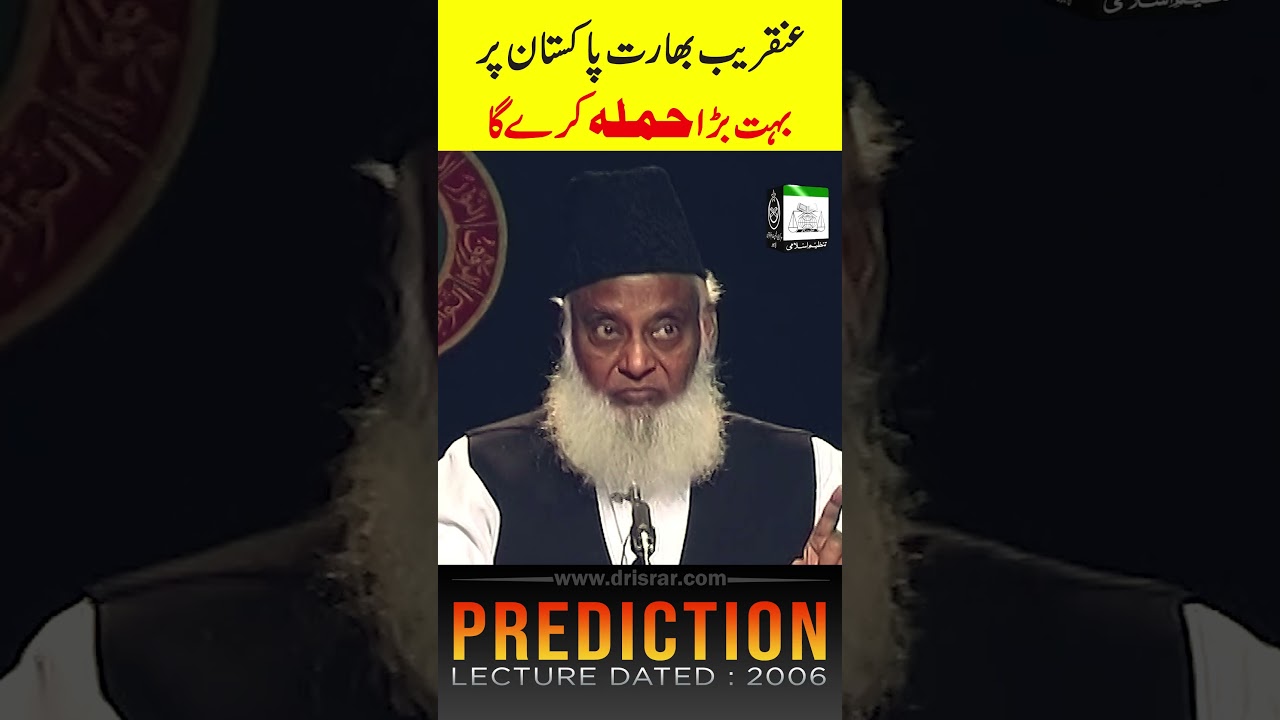
This lecture discusses a potential large-scale conflict between India and Pakistan if China and Pakistan strengthen their alliance. The speaker predicts a future Islamic revival originating from the region, even at a significant cost in lives. A key prophecy from Shah Aliullah Dehlavi foretells a time when the upper castes of India will predominantly convert to Islam. The lecture emphasizes the historical trajectory and inevitable changes occurring, acknowledging the inability to prevent these unfolding events.
64
