Corti
This lecture emphasizes dedicating one’s God-given eloquence and knowledge solely to the explanation and propagation of the Quran. It cautions against utilizing these gifts for personal financial gain or worldly pursuits. The speaker highlights that the best among people are those who learn and teach the Quran, understanding and conveying its message to others. True benefit lies in seeking and sharing religious knowledge.

385
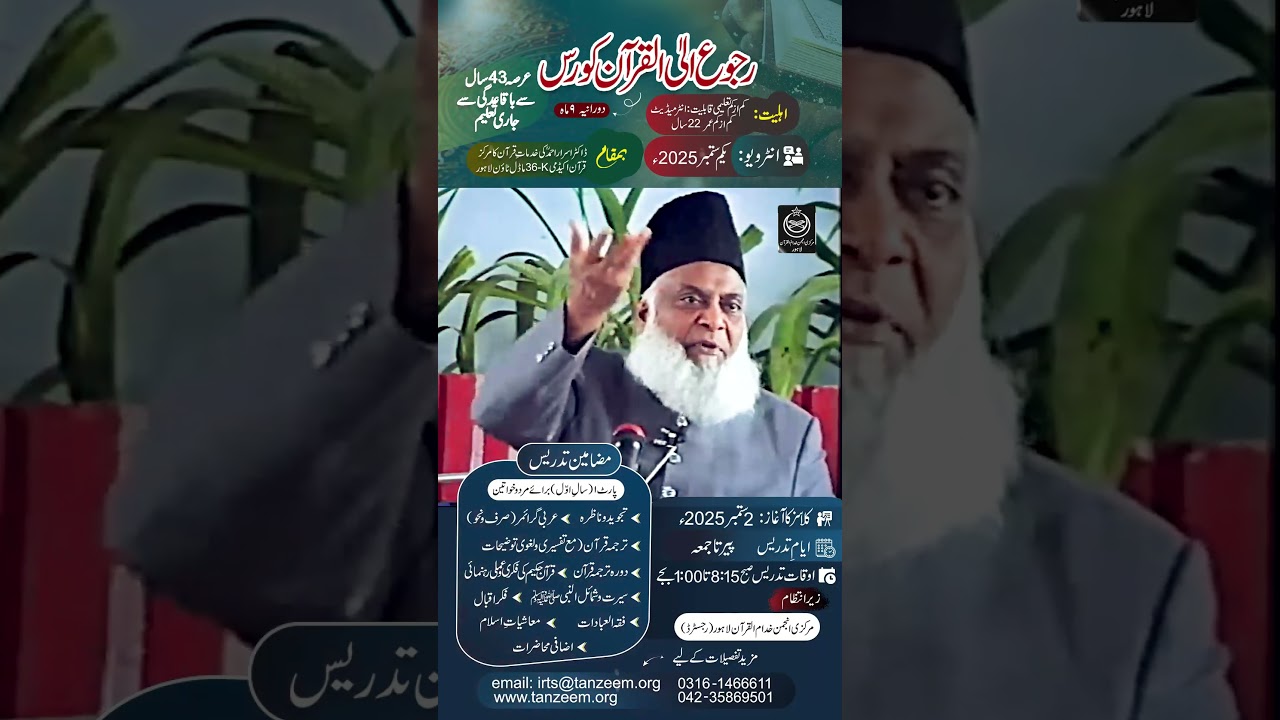
This lecture emphasizes the necessity of personal repentance (tawbah) and its expansion into a collective movement. It urges listeners to prioritize learning Arabic to properly understand and convey the Quran, as the primary medium for inviting others to the faith. The speaker stresses the urgency of life, the potential for unforeseen circumstances, and the importance of dedicating time to religious education and the preparation of a dedicated group (da'i) committed to spreading the message of Islam. He shares his life's dedication to Quranic study, teaching, and the organization of a committed group, viewing this as a vital struggle for the faith. The ultimate goal is the growth of a movement devoted to upholding and propagating Islamic principles.
63
This lecture categorizes people into three groups based on their relationship with faith and worldly desires. The first group possesses genuine faith, pure intentions, and benefits from divine guidance. The second group is consumed by materialism, devoid of true spirituality or meaningful good deeds, and spends wealth solely on personal indulgence. The third group occupies an intermediate position, performing good deeds motivated by ego, reputation, or worldly gain rather than sincere faith. Their actions are likened to a mirage, lacking genuine spiritual value. The lecture emphasizes the distinction between actions performed for the sake of Allah and those driven by self-interest.
60

The Prophet Muhammad (peace be upon him) stated that the greatest struggle is the internal battle against one's own base desires (nafs). External enemies are easier to confront; the true enemy resides within. This internal struggle, or *jihad*, against the commanding self is the most virtuous form of worship. The Prophet clarified that the most excellent form of *jihad* is striving against one’s *nafs* in obedience to God. This lecture explores the profound significance of self-discipline and spiritual refinement.
59
The entirety of the Prophet Muhammad’s life and revolution revolves around the Quran. All systems of invitation, training, and spiritual purification are centered on its teachings. To ensure the continued dissemination of this knowledge within an Islamic state or system, a consistent educational practice is vital. The Friday congregation (Jumah) is proposed as a weekly system for continuous learning and revival of Quranic teachings within the community.
33
Hajj involves performing specific rituals at designated locations. Pilgrims travel to Mecca, perform Tawaf around the Kaaba, and depart for Mina on the 8th or 9th of Dhulhijjah. They spend a night in Mina before proceeding to Arafat. The stay in Arafat is until sunset, after which pilgrims depart to Muzdalifah to offer the Maghrib and Isha prayers combined. All Hajj rituals are tied to specific places and times, requiring adherence to these conditions for proper completion.
74
