Shorts

The Prophet Muhammad (peace be upon him) serves as the best example for those who believe in God and the Day of Judgement, and who consistently remember God. The Quran provides guidance for all, but only those who are pious and fulfill specific conditions—faith in God and the afterlife, and constant remembrance of God—will truly benefit. This lecture highlights the Prophet’s life as a complete argument for humanity. The establishment of Islam's social justice system was achieved through persistent effort, hardship, sacrifice, patience, perseverance, and resilience, not through miracles or divine comforts. The example of the Battle of Tabuk demonstrates the dedication of early Muslims, even sharing meager rations to support one another. This is the essence of the Prophet’s legacy.

78
This lecture analyzes verse 55 of Surah Noor, explaining Allah’s promise to believers: establishing them as successors on Earth, granting dominance to their faith, and replacing their fear with security. The discussion highlights that true Tawhid (Oneness of God) is incomplete until the religion of Allah prevails. The verse connects political empowerment with spiritual fulfillment, asserting that genuine worship requires both faith and the ability to practice it without oppression. Dr. Israr Ahmad explains that the promise of governance is intrinsically linked to the establishment of Allah’s way of life and the eradication of fear among believers.
183
This lecture details the four characteristics that define a complete hypocrite, and the presence of even one of these traits indicates a degree of hypocrisy. These characteristics are: disloyalty when entrusted, lying when speaking, breaking promises, and losing control during disputes, escalating to abusive language and physical aggression. The speaker explains that true conflict resolution requires self-control and adherence to truthfulness, while the traits of a hypocrite lead to societal breakdown and discord. The lecture emphasizes that even a small amount of hypocrisy can be damaging and requires immediate self-correction.
73

This lecture addresses the plight of the impoverished, highlighting the harsh realities faced by those struggling to meet basic needs. It emphasizes that individuals preoccupied with daily survival – those who cannot consistently secure even two meals a day and labor for ten to twelve hours – are deprived of the capacity for spiritual contemplation. The speaker asserts that systemic poverty degrades humanity, reducing individuals to a bestial existence, akin to livestock. This degradation strips them of their dignity and their ability to connect with the divine.
1,424

This lecture discusses the inevitability of trials and tribulations, referencing a prophetic warning about a significant upcoming trial. Hazrat Ali inquired about the means of escape during this trial, prioritizing practical solutions over seeking to understand the ‘why’ or ‘how’ of its occurrence. The Prophet Muhammad (peace be upon him) responded that the Quran is the path to safety and deliverance during times of hardship. The focus is on proactive preparation and seeking refuge in divine guidance rather than solely analyzing the nature of the trial itself.
52
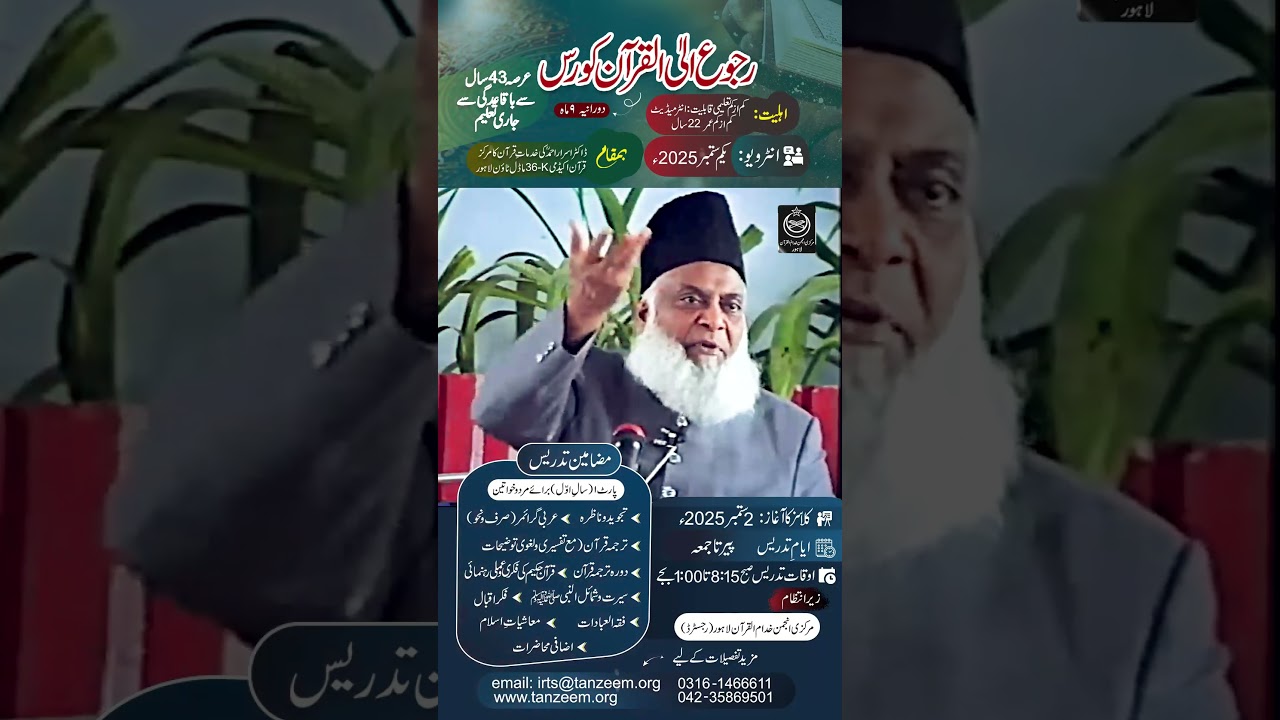
This lecture emphasizes the necessity of personal repentance (tawbah) and its expansion into a collective movement. It urges listeners to prioritize learning Arabic to properly understand and convey the Quran, as the primary medium for inviting others to the faith. The speaker stresses the urgency of life, the potential for unforeseen circumstances, and the importance of dedicating time to religious education and the preparation of a dedicated group (da'i) committed to spreading the message of Islam. He shares his life's dedication to Quranic study, teaching, and the organization of a committed group, viewing this as a vital struggle for the faith. The ultimate goal is the growth of a movement devoted to upholding and propagating Islamic principles.
63
