निकर
This lecture explores the divine protection of scriptures. It questions why, if God protected the Torah and Gospel, alterations still occurred. The argument centers on the unique preservation of the Quran, asserting that human intervention cannot corrupt its original form. The Quran's protection is explicitly stated in scripture, contrasting with the perceived lack of such protection for previous texts. Human translations and interpretations are acknowledged as sources of potential distortion, while the Quran itself remains inviolable.

45
This lecture addresses the rights and societal treatment of children born out of wedlock in Islam. It firmly states that such children bear no guilt for the actions of their parents and should be treated with the same respect and dignity as any other child. The speaker emphasizes that these children are considered relatives (mawali) and should not be stigmatized or held accountable for parental transgressions. Any wrongdoing remains the responsibility of the parents, and the child is considered innocent.
60
The Quran is uniquely preserved compared to all other texts. The world’s scholars acknowledge this fact. Every letter and pronunciation within the various recorded recitations – Sab’a Qira’at and ‘Ashara Qira’at – is meticulously documented, detailing even the use of *zabar* or *zir* for each word. The official text was standardized by Hazrat Uthman (RA), a significant service to the Muslim community. This preservation extends to the precise documentation of variations in recitation, ensuring the integrity of the divine text.
57
Partial obedience is ultimately disobedience. True faith demands complete submission to divine commands. Selective acceptance of religious tenets renders all obedience void. This lecture details the severe consequences outlined in Surah Baqarah, verse 85, for those who pick and choose which aspects of faith to follow. Such individuals face humiliation in this world and intensified punishment on the Day of Judgement. The core message emphasizes that the veto power resides within one's own desires, and yielding to them when it comes to divine commands is unacceptable. Complete and sincere obedience is essential for spiritual well-being and salvation.
65
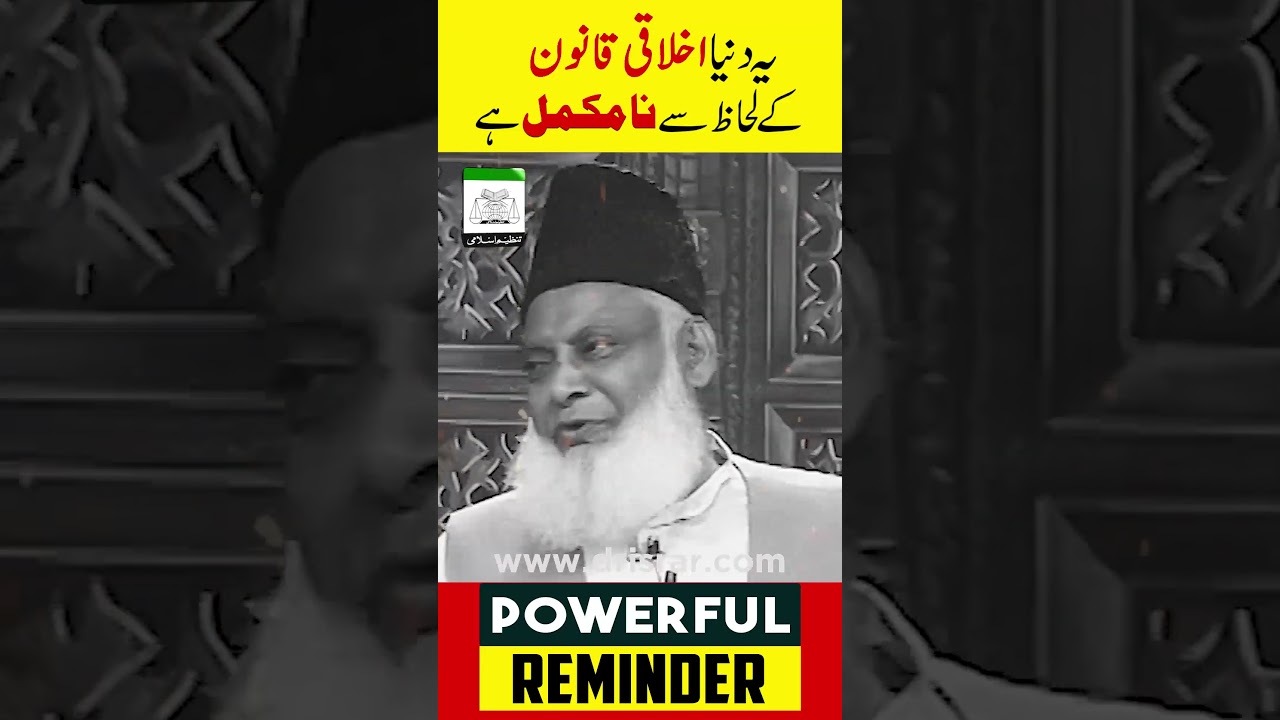
This world is fundamentally incomplete from the perspective of moral law. Physical laws operate with absolute certainty – transgression leads to consequence. However, moral failings, like lying or theft, often go unpunished in this life. This creates an inherent imbalance. A complete moral order, and the corresponding consequences for actions, necessitates another world, another existence where justice prevails. The speaker emphasizes the deficiency of this world’s system of accountability and advocates for a realm where moral principles are fully realized and upheld.
54
The lecture discusses the diminishing spiritual impact of ritualistic worship, despite the continuation of practices like prayer, fasting, sacrifice, and pilgrimage. It argues that simply performing these acts does not guarantee societal change or personal transformation. The speaker emphasizes that a significant number of pilgrims return from Hajj without exhibiting any noticeable positive impact on their communities or themselves, and some even become more self-assured in their past wrongdoings, feeling free from accountability. The core message is that true worship must lead to genuine inner change and positive societal contribution.
65
