شلوار کوتاه

Dr. Israr Ahmad unequivocally states that the 20th century’s greatest Islamic thinker was a lover of God and a herald of the revival of the Muslim community. He wasn’t merely aware of this revival, but actively foretold it, specifically predicting the resurgence of the Hashemite lineage. He proclaimed the imminent arrival of a book for the pure community, and a great leader from the Hashemite lineage. He was, therefore, both a scholar and a prophet of this revival, and most importantly, a beacon of the second Islamic era.

49
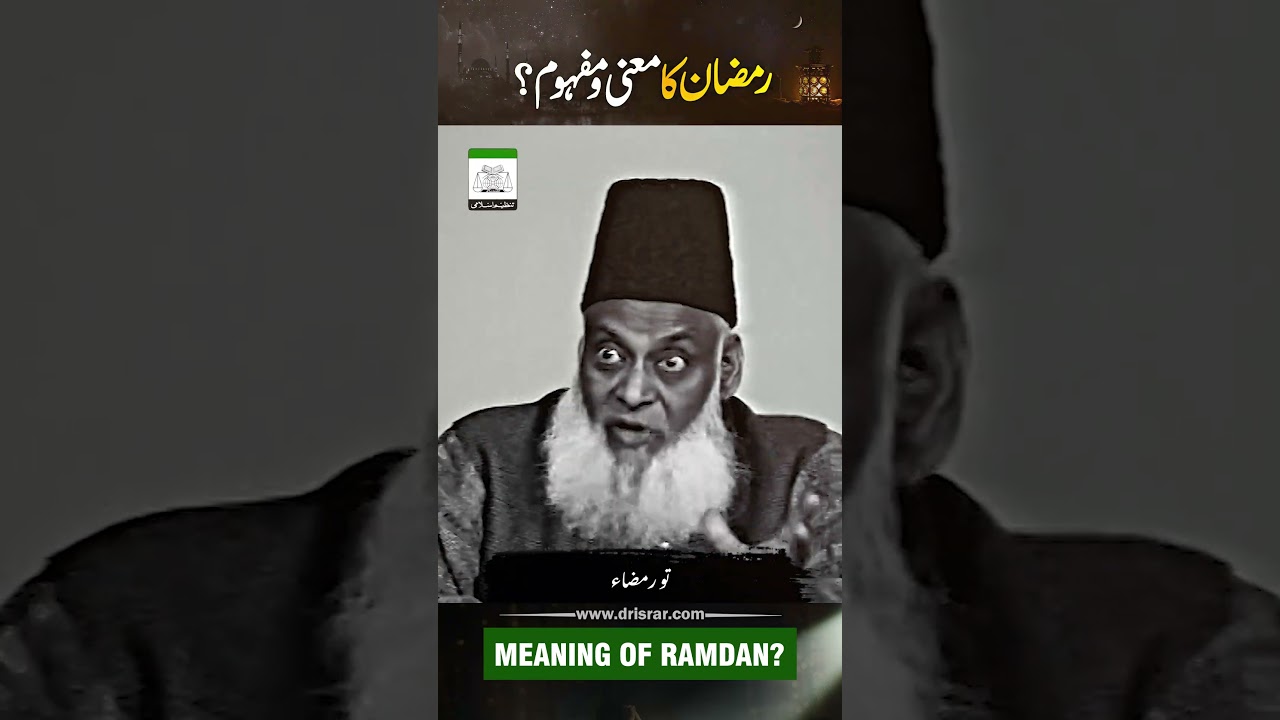
The name Ramadan originates from the intense heat that once prevailed in Arabia, causing hardship and even death. People perceived this time as one where purification occurred naturally. The month of Ramadan was thus associated with cleansing and seen as a period where accumulated impurities within the human body were naturally eliminated. The practice of fasting was ordained by God to facilitate this process. Another interpretation connects the name Ramadan to one of God’s names, signifying ‘the month of God.’ This is supported by a tradition of the Prophet Muhammad, who identified Sha’ban as his month and Ramadan as God’s month.
60

This lecture explores the concept of *noor* (light) as inherent within the human heart and soul, predating the revelation of the Quran. The Quranic light, upon its descent, awakens and activates this pre-existing inner illumination. This process is exemplified in the Prophet Muhammad’s life, where the Quran served as a catalyst for his inherent spiritual capacity. The Quran is presented as a divine guide, empowering the Prophet to lead humanity towards righteousness. The lecture emphasizes the transformative power of the Quran in illuminating the inner self and guiding others towards the straight path.
58

Dr. Israr Ahmad explains that memorizing the Quran is one task, and *retaining* it is another. Forgetting memorized verses is a serious offense. Consistent recitation and revision are crucial for long-term retention. Many who claim to have memorized the entire Quran struggle to recall it throughout the year, requiring frequent re-memorization. He highlights that consistent practice is more valuable than merely claiming complete memorization, even if one is unable to perform regular prayers.
60

This lecture explains that Allah hears and responds to every sincere call and prayer, regardless of location or circumstance. It clarifies that proximity to sacred places like the Haram or Arafat doesn't create a greater connection with Allah; He is always near. The speaker refutes the notion that one cannot directly communicate with Allah, emphasizing that such beliefs stem from polytheistic ideologies. Allah is ever-present and accessible to those who turn to Him sincerely. The lecture stresses that Allah is not distant but close to those who call upon Him and that true connection comes through sincerity, not location.
66

This lecture differentiates between *munazra* (debate) and *mujadla* (dialogue). *Mujadla* focuses on invitation and mutual respect, prioritizing the other party’s feelings and aiming to increase wisdom. *Munazra*, conversely, aims for victory and silencing the opponent, characterized by harshness and aggression. The term *munazra* does not appear in the Quran, highlighting a key distinction in approach.
67
