Shorts
This lecture addresses the rights and societal treatment of children born out of wedlock in Islam. It firmly states that such children bear no guilt for the actions of their parents and should be treated with the same respect and dignity as any other child. The speaker emphasizes that these children are considered relatives (mawali) and should not be stigmatized or held accountable for parental transgressions. Any wrongdoing remains the responsibility of the parents, and the child is considered innocent.

54
The Quran provides guidance on two primary levels: intellectual and practical. It addresses fundamental philosophical questions concerning the nature of existence, life, truth, and morality—exploring concepts such as the universe, the meaning of life, knowledge, right and wrong, good and evil. Simultaneously, the Quran offers a comprehensive system of practical directives governing individual and collective life, encompassing religious obligations, ethical guidelines, economic principles, and social norms. This dual approach provides both intellectual understanding and actionable guidance for humanity.
47
The Quran does not contain a direct command regarding beards. However, the Quran mentions the beard of Pharaoh, which Moses grasped. The practice of maintaining a beard is considered a tradition (Sunnah) of all prophets, and strongly emphasized by the Prophet Muhammad. While not a mandatory obligation (fard) in the Quran, it is a confirmed Sunnah (Sunnat-e-Muakkadah) and, according to some scholars, approaches the level of a religious obligation (wajib). Following this confirmed Sunnah is recommended, though not considered a mandatory religious duty.
62
Many misconceptions exist regarding remembrance of Allah. A primary error is conflating *zikr* itself with the *means* of remembrance. *Zikr* is the presence of Allah in the heart – maintaining awareness, love, and connection with Him. Reciting phrases like “Subhan Allah” is a *means* to *zikr*, but not *zikr* itself. If one’s mind is preoccupied with worldly problems while reciting, the *means* is employed, but the true *zikr* – the presence of Allah in the heart – is not achieved. Similarly, prayer is a *means* to *zikr*; the ultimate goal is the presence of Allah within the heart.
87
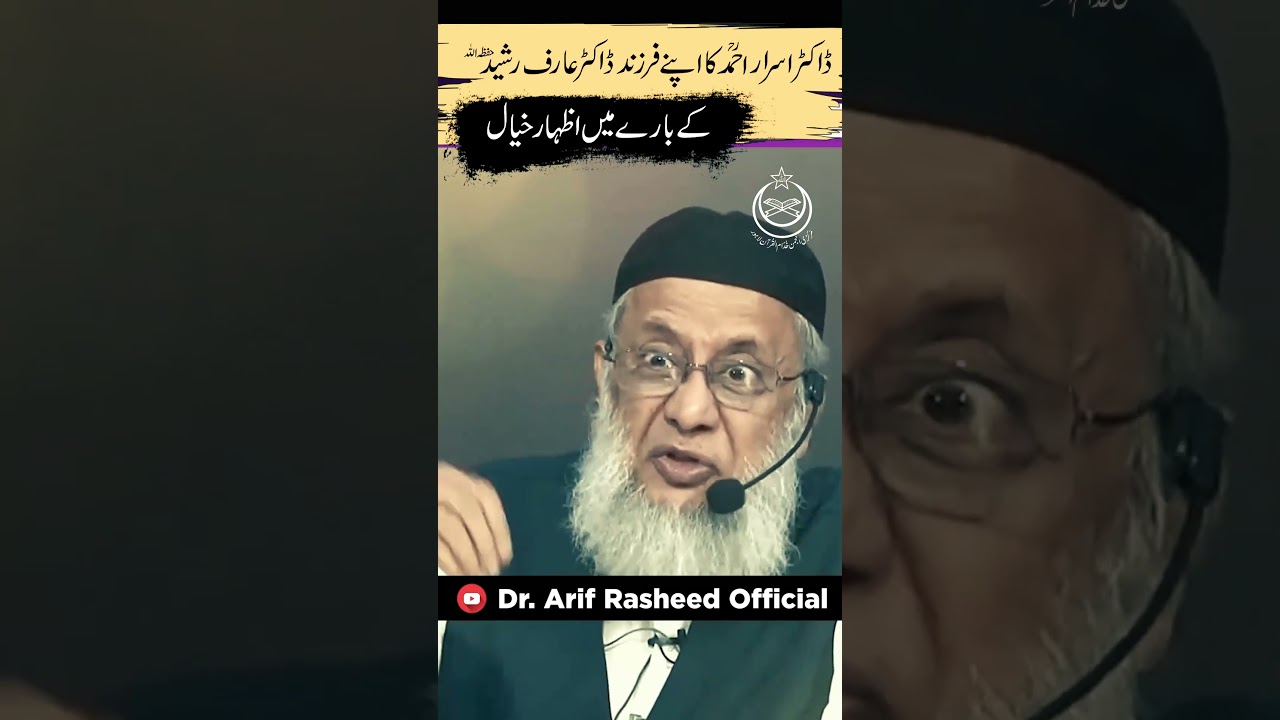
Dr. Israr Ahmad discusses the succession of Dr. Arif Rashid, highlighting their shared background in medicine and a long-standing relationship spanning decades. He notes Dr. Rashid’s similar voice and demeanor, expressing hope that he will fulfill the responsibilities of his new position. Dr. Ahmad recalls Dr. Rashid attending his lectures since childhood, beginning in 1965, and the deep impact of those lessons on his formative years. He believes Dr. Rashid carries the essence of his teachings and thought processes.
50
Early Arabs primarily believed in Allah, though they also worshipped various deities and idols. They believed these idols would intercede on their behalf in the afterlife. While many acknowledged the existence of the afterlife, they struggled to reconcile the concept of resurrection with the physical decay of the body. Some believed their deities would protect them, reflecting a complex blend of monotheistic and polytheistic beliefs. This lecture explores the nuances of their faith and understanding of the divine and the hereafter.
28
