السراويل القصيرة
Sheikh Abdul Qadir Jilani emphasized that true power and provision come solely from Allah. Nothing possesses inherent efficacy; fire cannot burn, water cannot drown, poison cannot kill, or anything benefit without Allah’s will. Reliance should be placed entirely on Allah, not on worldly means or intermediaries. The lecture stresses complete trust in Allah for all needs and outcomes.

57
This lecture clarifies that true success isn't measured by wealth, possessions, or business expansion. Instead, it's achieved through four core principles: faith (iman), righteous deeds (amal-e-saleh), encouraging truthfulness (tawasib-ul-haq), and patience (tawasib-e-sabr). The speaker argues that conventional definitions of success are fundamentally flawed and that these four elements are the genuine determinants of a fulfilling life. This lecture highlights a contrast between worldly perceptions of success and the Islamic perspective, offering a pathway to genuine achievement.
54
This lecture explores the destructive nature of greed (bakhili) and the dangerous state of self-sufficiency (istighna). It contrasts those who are mindful of others’ feelings and seek forgiveness with those who are indifferent and act without regard for consequences. The speaker emphasizes that a lack of empathy leads to spiritual ruin, ultimately culminating in the severe consequences of the afterlife. The discourse highlights the importance of humility, consideration for others, and seeking repentance to avoid the path of destruction.
54
This lecture explores the perspective of M.N. Roy, a prominent communist revolutionary, on the historical significance of Islam. Roy, a key figure in the Comintern, recognized the revolution initiated by Muhammad as one of the greatest in human history. He detailed this view in his book, *The Historical Role of Islam*, acknowledging its profound impact on global events. Dr. Israr Ahmad analyzes Roy’s analysis and provides insightful commentary on the topic.
66
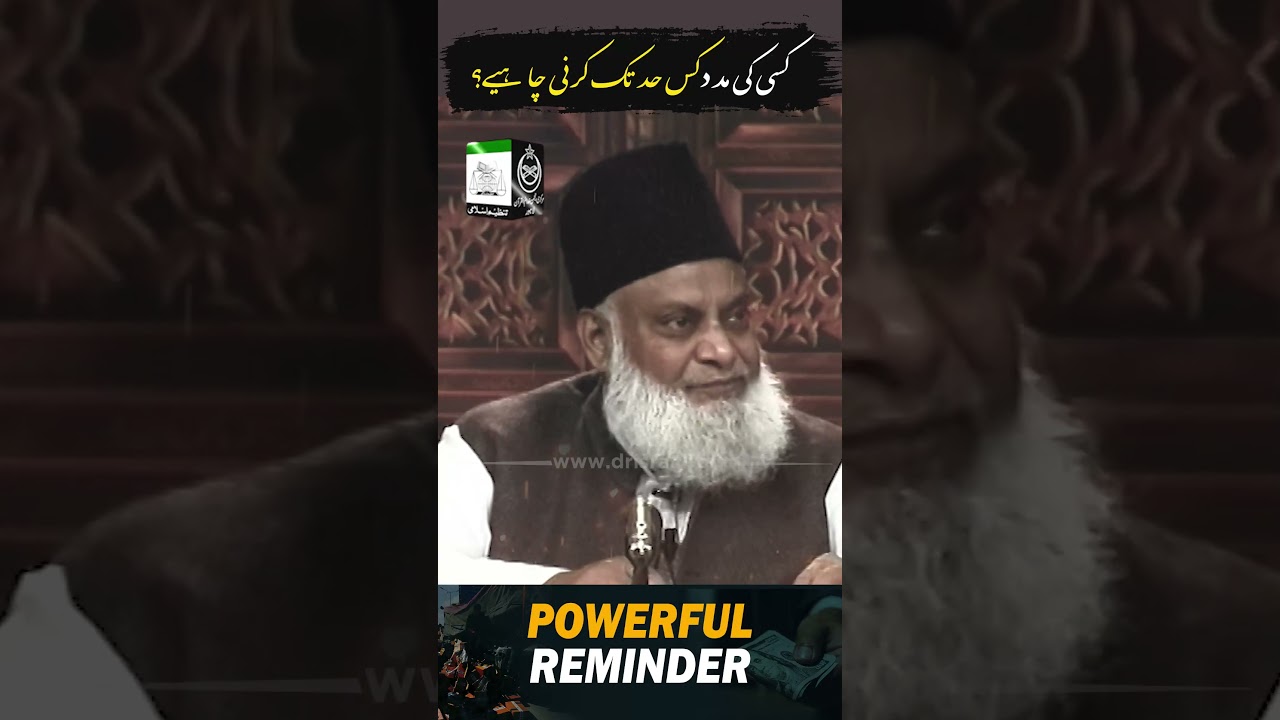
This lecture discusses the Islamic perspective on charitable giving and the rights of heirs. A companion of the Prophet Muhammad (peace be upon him) inquired about donating all his wealth for the sake of Allah. The Prophet advised against leaving heirs destitute, emphasizing their rightful share. The companion then proposed donating half, then a third, with the Prophet accepting the one-third contribution as appropriate. This highlights a balanced approach to charity, respecting both the act of giving and the welfare of one’s family.
66
This lecture critiques the hypocrisy prevalent within religious observance, highlighting a focus on outward rituals while neglecting inner spirituality. It emphasizes the dangers of superficial adherence to faith, comparing it to beautifully decorated tombs concealing decay within. The speaker argues that genuine faith requires a connection to the divine, not merely outward displays of piety. The discussion extends to contemporary issues of materialism, corruption, and the loss of spiritual values, drawing parallels between past and present societal failings. The lecture underscores the importance of cultivating a sincere relationship with God and striving for inner transformation.
58
