Celana pendek

This lecture explores the boundless power and knowledge of Allah. It emphasizes humanity's limited capacity to fully comprehend divine attributes. The speaker highlights the vastness of creation, from the Earth to the galaxies, and how our understanding falls short. The discussion centers on recognizing Allah’s absolute power while acknowledging the limits of human perception and intellect. It asserts that while we cannot measure Allah’s attributes, we can perceive His signs and become grateful worshippers. The lecture underscores the importance of acknowledging Allah’s greatness and submitting to His will.

60
The core demand of faith is singular and absolute. Fulfilling this single requirement guarantees salvation, success, guidance, and ultimate happiness. This lecture emphasizes the simplicity and completeness of this divine demand, highlighting its all-encompassing nature and its connection to achieving true fulfillment in life. It underscores that adherence to this single principle unlocks all blessings and leads to a meaningful existence.
89
This lecture emphasizes the importance of fulfilling obligations to God and humanity. It stresses standing firm for justice and truth, and adhering to divine guidance as outlined in the Quran and previous scriptures. The speaker highlights the interconnectedness of rights – those owed to God, the Prophet, and fellow human beings. A crucial aspect is the responsibility to understand and reflect upon the scriptures received, particularly the Quran, Torah, and Gospel, and to act upon their teachings. The message underscores that true communication with God requires commitment to justice and adherence to revealed knowledge.
66

This lecture explores the concept of divine guidance and its profound impact on human life. It emphasizes that success and righteousness are not achieved through personal effort alone, but are gifts from God. The speaker highlights the importance of recognizing God's favor and the potential for life to drastically change with even the smallest deviation. It underscores that all praise and gratitude belong to God, who bestows guidance and directs individuals toward the right path. The lecture serves as a reminder of God's grace and the need for constant acknowledgment of His blessings.
67

This lecture explores the multifaceted greatness of the Prophet Muhammad (peace be upon him). It highlights his exceptional qualities not merely as a human being, but also as a strategic leader and diplomat. The discussion focuses on his unparalleled skill in military strategy, despite never personally participating in battle, and his mastery of negotiation and conflict resolution. The lecture details his ability to forge alliances and unite diverse groups, exemplified by the agreements he established in Medina and previously in Yathrib, demonstrating his profound leadership and wisdom.
81
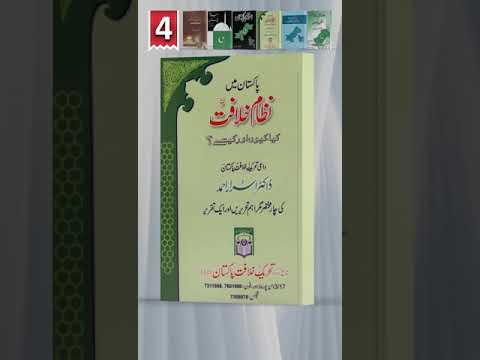
This collection of lectures by Dr. Israr Ahmad addresses critical questions about Pakistan’s history, ideology, and future. Topics include the legacy of the founder of Tanzeem-e-Islami, the viability of a caliphate system, the historical and political context of Islam in Pakistan, the factors contributing to Pakistan’s instability, and the reality of the Pakistan Ideology. The set also features Dr. Ahmad's analysis of Pakistan's political landscape from 1977 to 1987. Available for ₨1200 (originally ₨1900) from Maktaba Khuddam-ul-Quran, Lahore. Home delivery is free with cash on delivery. Order online at www.maktaba.com.pk or WhatsApp at 0301-1115348.
58
