Shorts

The speaker clarifies the distinction between legitimate leasing (ijara) and purchases financed through interest (riba). Leasing involves renting an asset for a specified period, with the renter paying a monthly fee and covering operational costs. In contrast, an interest-based purchase involves financing the full price of an asset over time, accruing interest on the outstanding amount. The speaker emphasizes that financing a purchase with interest, even if labeled differently, constitutes riba and is prohibited. Legitimate leasing does not involve any form of interest or profit on the asset itself, only a rental fee for its use. The discussion highlights that changing the label of an interest-based transaction does not alter its fundamentally prohibited nature.

60
This lecture details the Prophet Muhammad’s (PBUH) unique mission, distinguishing it from those of previous prophets. The Prophet’s unwavering integrity, self-reliance, and dedication to establishing a complete system of life are emphasized. The discussion highlights the two phases of the prophetic mission: initial, common to all prophets (invitation to God, glad tidings, warnings), and the unique, comprehensive mission given to Muhammad (PBUH) – establishing a complete way of life based on divine guidance. The Quranic verses from Surah Taubah, Surah Safah, and Surah Fatah, which repeatedly emphasize this comprehensive mission, are referenced. The lecture underscores the Prophet’s unparalleled commitment to implementing a complete system of life, a responsibility not shared to the same extent by previous prophets.
59
All humans are born equal, possessing inherent dignity regardless of birth, race, or gender. Social hierarchies are not innate but are acquired through knowledge, piety, and character. True honor is derived from devotion to God, with the most esteemed individual being the most righteous. While men may hold institutional leadership roles within the family, this does not equate to inherent superiority. Women can surpass men in moral and spiritual standing. Examples like Maryam, Khadija, Asiya, and Aisha demonstrate the potential for women to achieve exceptional spiritual heights. The core message emphasizes equality, character, and spiritual elevation as the foundations for respect and honor.
47
The essence of sacrifice lies in acknowledging Allah as the sole deity and submitting to Him. Without this spiritual connection, rituals like sacrifice, prayer, fasting, and pilgrimage become meaningless formalities. True devotion stems from a genuine relationship with Allah, transforming actions into sincere worship. The core of sacrifice is not merely the act itself, but the underlying recognition of God’s sovereignty and one’s complete surrender to His will. Without this internal state of piety, all external observances are rendered futile.
71
True faith is deeply rooted conviction in the heart—belief in God, His attributes, His presence and knowledge, life after death, accountability, reward and punishment, Paradise and Hell, angels, divine revelation, scriptures, prophets, messengers, and the finality of the prophethood of Muhammad, peace be upon him. This conviction is the foundation of a meaningful life.
35
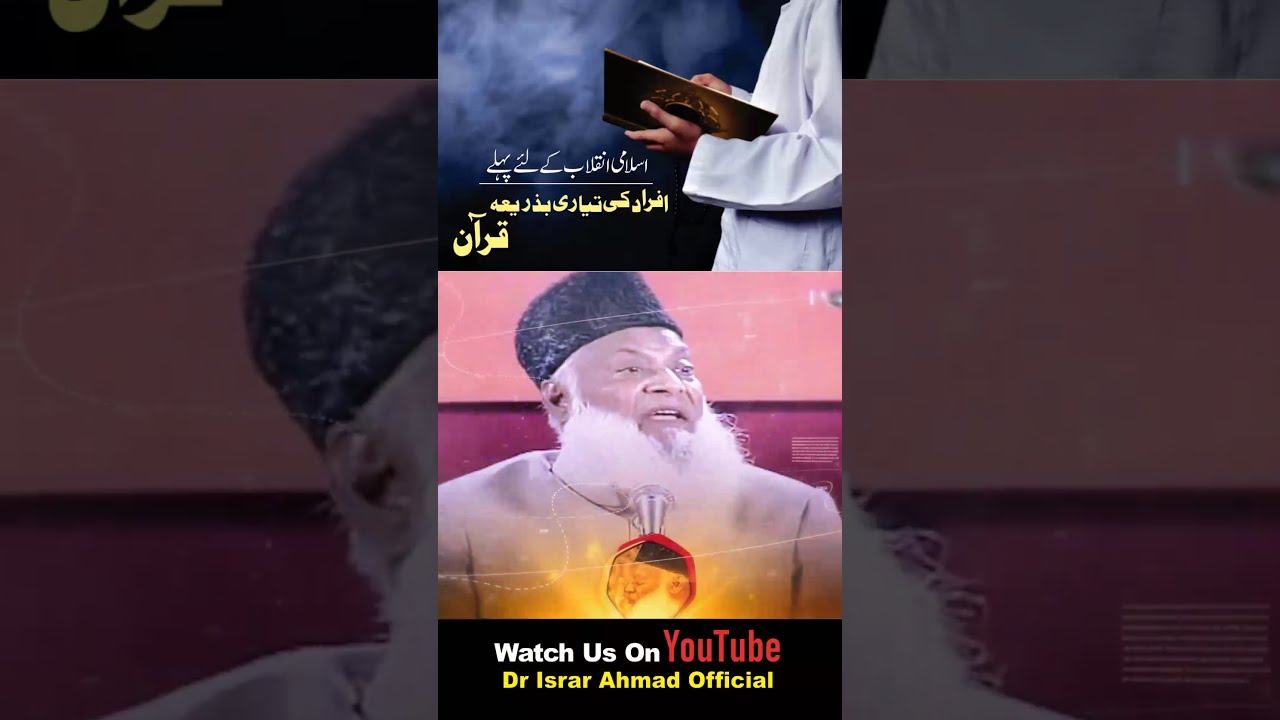
Dr. Israr Ahmad emphasizes the pivotal role of the individual in shaping the destiny of nations. He asserts that a nation's fate rests in the hands of its people, with each individual acting as a guiding star for the community. True progress stems from individual piety, devotion, and sincerity of purpose – working solely for the pleasure of God and striving for success in the afterlife. This lecture stresses the importance of solidifying individual character before uniting for collective advancement, with the Quran as the essential binding force.
81
