Shorts

This lecture emphasizes the individual responsibility to actively oppose wrongdoing. It asserts that every person has a duty to counter evil, first through direct action if capable, and if not, through vocal opposition. Remaining silent in the face of injustice is condemned as akin to supporting it, and even if unable to speak out, a strong internal aversion to evil must be maintained. The speaker warns against inviting divine wrath through inaction and complicity.

290
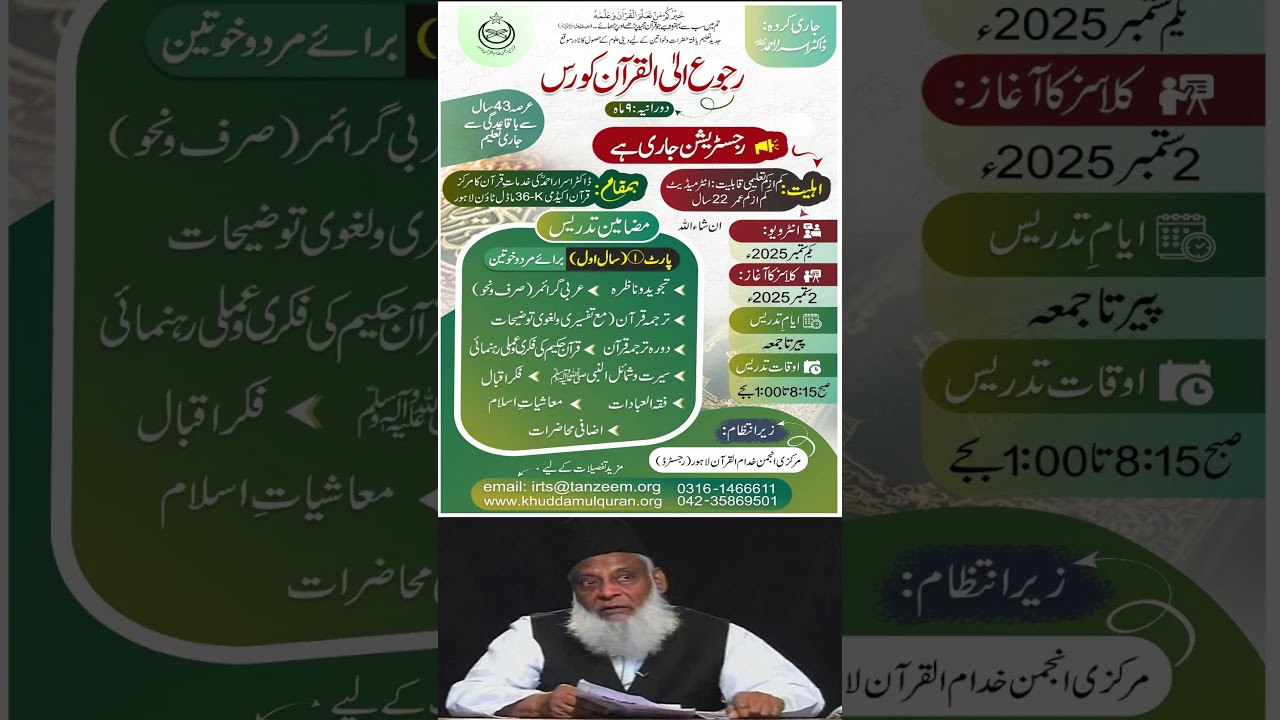
This lecture emphasizes the importance of learning Arabic to understand the Quran. It addresses the paradox of educated individuals lacking religious literacy, highlighting the financial strain families endure to provide education that doesn’t prioritize foundational Islamic knowledge. The speaker urges parents to invest in their children’s spiritual development by prioritizing Arabic and Quranic studies, framing it as a continuous charitable act. He appeals to prioritize this education, even amidst financial hardship, as a legacy of faith and understanding for future generations. The lecture stresses the value of dedicating nine months to learning Arabic and comprehending the Quran's message.
68
This lecture emphasizes the importance of a firm commitment to Allah and adherence to the Quran as a means of spiritual connection. It highlights the initial step of resolute intention and consistent effort in pursuing this path. The discussion focuses on prayer and charity as foundational practices, acknowledging the challenges and obstacles that arise during spiritual growth. The speaker encourages perseverance and reliance on Allah's guidance throughout the journey.
74
True blessings lie not in possessions like health, wealth, or children, but in the guidance that accompanies them. Without divine direction, these are merely transient comforts. The greatest blessing is the Quran, the source of ultimate guidance and true well-being. Guidance transforms all aspects of life into genuine blessings, while its absence renders even apparent advantages meaningless. The essence of a fulfilling life rests on seeking and adhering to divine direction.
312

This lecture analyzes the French and Russian Revolutions, highlighting their incomplete nature. Both revolutions primarily altered the political structure while leaving core beliefs, social systems, values, and economic institutions largely unchanged. The Bolshevik Revolution uniquely transformed the economic framework by abolishing private ownership and nationalizing resources, yet it did not affect the fundamental beliefs or social values. This discussion emphasizes how revolutions often fail to achieve comprehensive societal change, focusing instead on specific structural adjustments.
74

The Prophet Muhammad (peace be upon him) observed Tarawih prayers individually for only three nights, leading an eight-rak’ah congregation. He performed these prayers after the Tahajjud prayers. The practice of offering twenty rak’ahs in congregation did not exist during the Prophet’s era or the caliphate of Abu Bakr. It began during the caliphate of Umar ibn al-Khattab, who standardized the practice after observing fragmented congregations in the mosque. He instituted a system of twenty rak’ahs to be performed immediately after Isha, led by a single imam.
85
