Pantalones cortos

True goodness originates from faith, manifesting as sincere intention and the pursuit of Allah’s pleasure. This involves acting with love for God and ensuring actions are righteous and beneficial. The most prominent expression of goodness is selfless service to humanity, driven by compassion. This includes prioritizing support for family, orphans, the poor, travelers, those in need, and freeing the oppressed. Good deeds are not merely for worldly reward, but for eternal recompense.

55

Time is presented as a powerful, swift force that relentlessly diminishes life. The speaker emphasizes that age isn't increasing, but rather decreasing with each passing moment. A person’s lifespan is finite; preoccupation with frivolous activities wastes this precious resource. A truly mindful and devout individual understands time’s value and refrains from squandering it on trivial pursuits. The lecture stresses the importance of recognizing time’s fleeting nature and utilizing it for meaningful endeavors. It highlights that a decreasing lifespan necessitates a focus on purpose and avoiding wasteful activities.
41
The lecture discusses the diminishing spiritual impact of ritualistic worship, despite the continuation of practices like prayer, fasting, sacrifice, and pilgrimage. It argues that simply performing these acts does not guarantee societal change or personal transformation. The speaker emphasizes that a significant number of pilgrims return from Hajj without exhibiting any noticeable positive impact on their communities or themselves, and some even become more self-assured in their past wrongdoings, feeling free from accountability. The core message is that true worship must lead to genuine inner change and positive societal contribution.
57
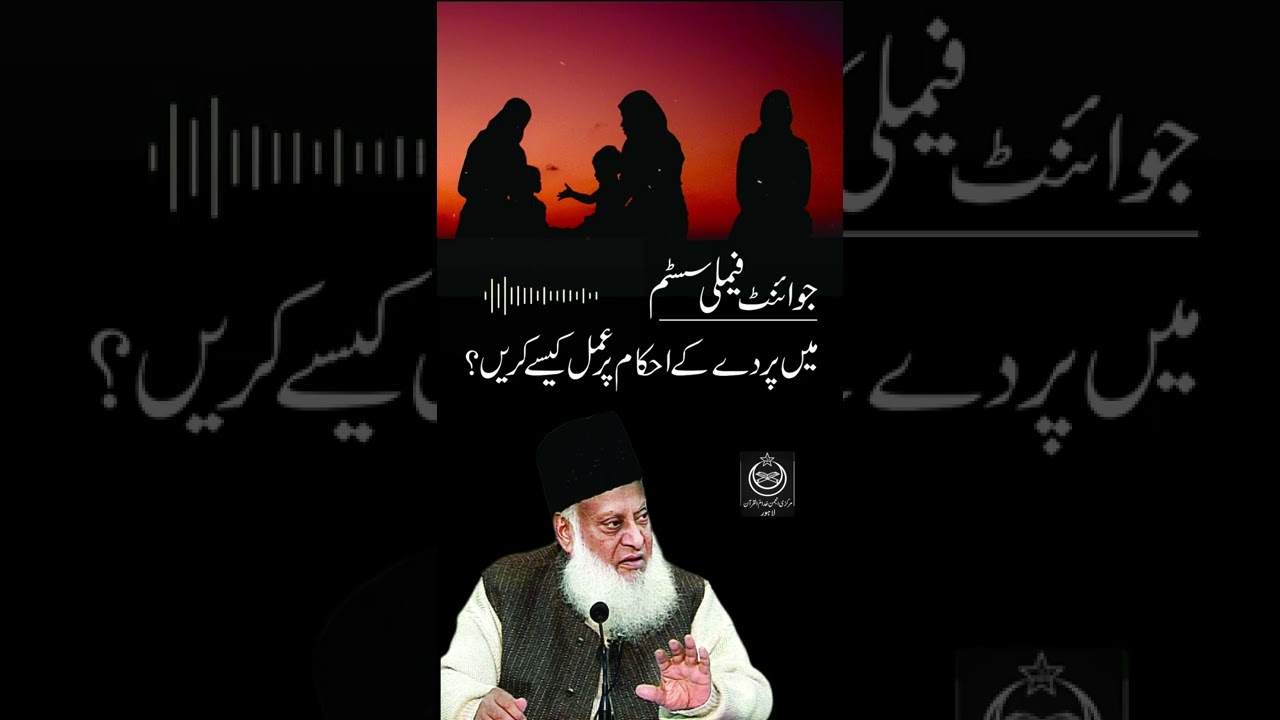
This lecture discusses the application of *purdah* (modesty/seclusion) within a joint family system. Dr. Israr Ahmad explains that while strict adherence to *purdah* as practiced between separate households isn't possible, certain guidelines can be followed. These include avoiding direct face-to-face interaction between a younger brother's wife and her husband’s elder brother, maintaining distance, and ensuring privacy during work or activities where unrelated men may be present. The discussion uses an example of a woman working while maintaining *purdah* from male relatives and outsiders.
81

During the time of Lord Wellington, the British government offered Allama Iqbal a governorship in South Africa, with the condition that Begum Iqbal accompany him to all official events. Iqbal declined, stating that while he may be a flawed Muslim, he would not compromise his wife's modesty for a government position. This incident, documented by Maulana Maududi in *Batool* magazine (April 1978), highlights Iqbal’s commitment to Islamic values. He similarly refused to attend a foreign delegation where wives were expected to accompany their husbands, upholding his wife’s observance of *purdah* (veil).
82

Dr. Israr Ahmad explains that contemporary Urdu utilizes easily understood vocabulary rooted in common usage. He points out that words like ‘Asr’ (era/time) and ‘Khassara’ (loss) are well-established in Urdu. The lecture emphasizes that even words with Arabic origins are integrated naturally into the language, demonstrated by terms like ‘Iman’ (faith) and ‘Wasi’at’ (breadth). The discussion highlights the seamless blend of Arabic and Urdu, making the language accessible and relatable.
50
