Kratke hlače
The Prophet Muhammad (peace be upon him) stated that Allah showed him the entire Earth, its east and west. This revelation signifies that the influence and dominion of his community will eventually extend to all corners of the world. A further hadith indicates that no dwelling or nomadic settlement will remain where the message of Islam does not enter. This can happen either through acceptance of Islam by its inhabitants or through their submission to its principles. This lecture explores the implications of these prophecies for the future of Islam and its global reach.

56
This lecture explores the critical importance of trustworthiness and fulfilling promises in Islam, drawing from a hadith narrated by Hazrat Anas bin Malik. The Prophet Muhammad (peace be upon him) emphasized that a person lacking trustworthiness and commitment to their word lacks both faith and religion. The discussion highlights that upholding promises is a fundamental pillar of a believer's character and a crucial component of a strong moral foundation. The lecture underscores the severe consequences of dishonesty and the rewards of being a person of one's word.
49
This lecture discusses the foundational principles of Pakistan’s political system, highlighting its historical roots in British parliamentary democracy. It emphasizes the concept of a shared national identity encompassing both Muslims and non-Muslims, established during the creation of Pakistan. The speaker points out that despite establishing Pakistan with a different vision, the country largely retained the British parliamentary system. The lecture examines the perception that this system was considered divinely ordained, leaving little room for alternative models and solidifying its place as the established political norm.
70
This lecture details the four levels of modesty (pardah) prescribed in Islam. The first level involves segregation of genders in social settings. The second concerns appropriate attire when leaving the home, evolving from the jilbab to the burqa for increased ease and protection. The third level restricts access to the home to only close male relatives (mahram). Finally, the fourth level mandates covering the entire body even before mahram relatives, leaving only the face, hands, and feet exposed. The speaker emphasizes that these principles are being eroded in modern times, representing a deliberate attack on Islamic teachings.
62

The human soul inherently possesses two crucial elements: divine knowledge ('ma'rifat-e-Rabbani') and divine love ('mohabbat-e-Rabbani'). These are present as a radiant light and inner warmth, often obscured by layers of heedlessness, desire, ego, and pride. These obscuring layers deepen with increased indulgence in worldly desires or the development of arrogance, concealing the soul's innate connection to the divine. Removing these layers reveals the glowing ember of spiritual awareness and affection already within.
48
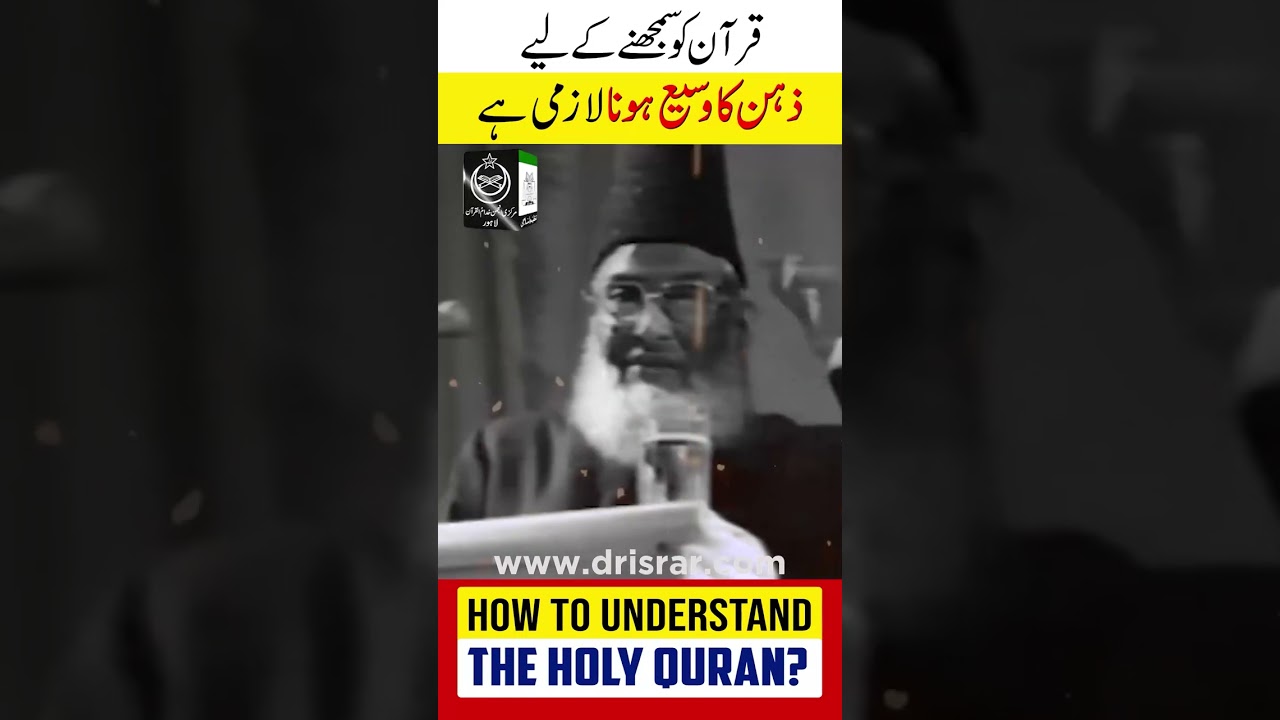
The capacity to receive and benefit from divine knowledge, specifically the Quran, is directly proportional to one’s mental capacity. Just as a small bucket can only hold a limited amount of water from a vast ocean, a limited mind can only absorb a fraction of the Quran’s wisdom. Expanding mental capacity through the study of sciences, philosophy, and logic is essential to fully grasp the Quran’s teachings. A broad and sharp mind is more receptive to understanding the subtleties and depths of divine knowledge. Continuous learning and intellectual exploration are vital for maximizing one’s capacity to benefit from the Quran's guidance and wisdom.
45
