السراويل القصيرة
The Prophet Muhammad (peace be upon him) was asked about the most virtuous form of migration. He responded that the most excellent migration is abandoning everything displeasing to God. This necessitates a personal assessment of one’s life and the eradication of actions contrary to the spirit of Islamic law. The lecture emphasizes immediate action, stating that the time for rectifying oneself is now, before it is too late. It's a call for sincere repentance and a commitment to living a life aligned with divine guidance.

236
The text discusses the immense scale of future conflicts, referencing battles and wars described in prophetic traditions. It highlights a catastrophic war, described as ‘The Great Battle,’ characterized by widespread death and destruction. The area most affected will be the Arab world. The text emphasizes the severity of this coming conflict, predicting a level of carnage so extensive that even birds will be unable to find a place to land without stepping on corpses.
86
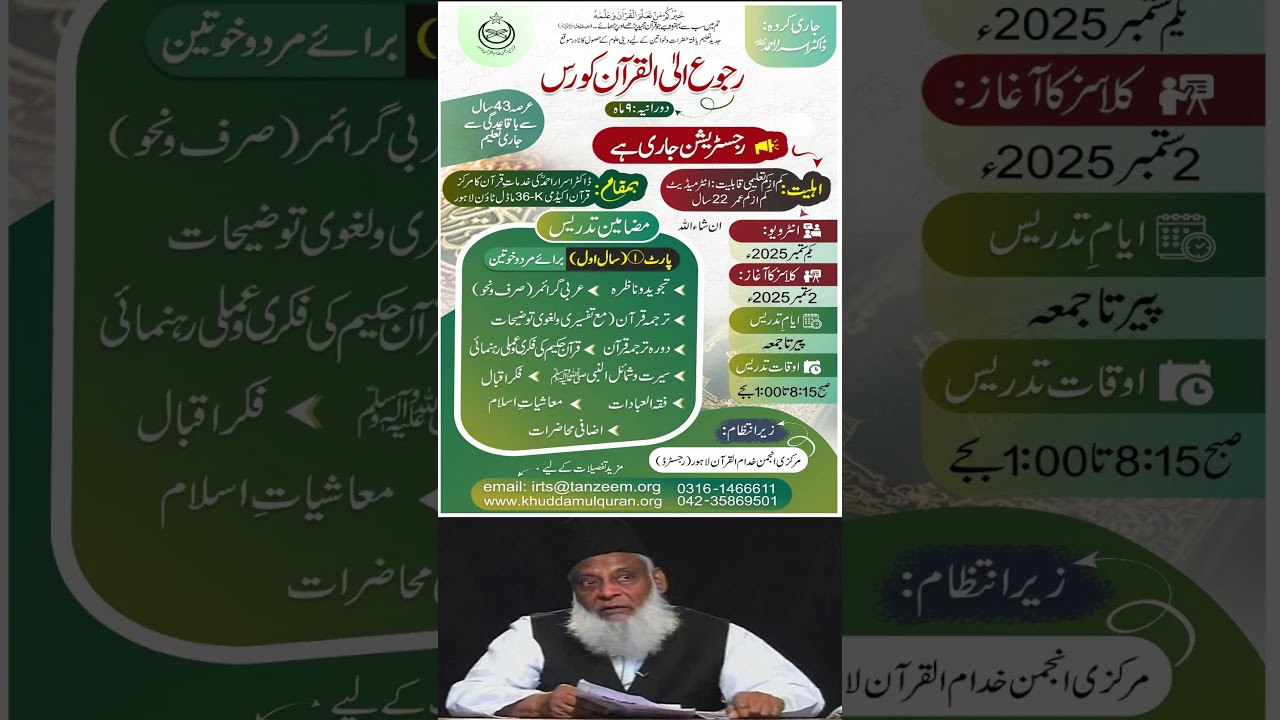
This lecture emphasizes the importance of learning Arabic to understand the Quran. It addresses the paradox of educated individuals lacking religious literacy, highlighting the financial strain families endure to provide education that doesn’t prioritize foundational Islamic knowledge. The speaker urges parents to invest in their children’s spiritual development by prioritizing Arabic and Quranic studies, framing it as a continuous charitable act. He appeals to prioritize this education, even amidst financial hardship, as a legacy of faith and understanding for future generations. The lecture stresses the value of dedicating nine months to learning Arabic and comprehending the Quran's message.
68
Time is presented as a powerful, swift force that relentlessly diminishes life. The speaker emphasizes that age isn't increasing, but rather decreasing with each passing moment. A person’s lifespan is finite; preoccupation with frivolous activities wastes this precious resource. A truly mindful and devout individual understands time’s value and refrains from squandering it on trivial pursuits. The lecture stresses the importance of recognizing time’s fleeting nature and utilizing it for meaningful endeavors. It highlights that a decreasing lifespan necessitates a focus on purpose and avoiding wasteful activities.
50
Surah Al-Asr is among the shortest chapters of the Quran, consisting of only three verses. It is also among the earliest revealed chapters. The Quranic style, as described in Surah Hud, is to first establish firm principles and then elaborate upon them, originating from the All-Wise, All-Knowing. This lecture by Dr. Israr Ahmad explores the significance of Surah Al-Asr and its message of time, loss, and the importance of faith and righteous deeds.
66
The speaker asserts that citizens have a right to strive for systemic change, differentiating between opposition to the state and opposition to the government. He identifies elections and peaceful agitation as the two primary means of achieving this change. He contends that elections alone are insufficient, as they merely replace faces within the existing socio-economic structure. True change necessitates agitation led by individuals who have first established righteous conduct in their own lives. The speaker emphasizes the importance of peaceful protest, devoid of violence or property damage, and a willingness to sacrifice for the cause.
54
