Shorts

This lecture discusses the Islamic perspective on charitable giving and the rights of heirs. A companion of the Prophet Muhammad (peace be upon him) inquired about donating all his wealth for the sake of Allah. The Prophet advised against leaving heirs destitute, emphasizing their rightful share. The companion then proposed donating half, then a third, with the Prophet accepting the one-third contribution as appropriate. This highlights a balanced approach to charity, respecting both the act of giving and the welfare of one’s family.

62

Surah Al-Ikhlas is considered the most important surah in the Quran due to its comprehensive articulation of Tawhid (the Oneness of God). While comprising only four verses, it’s equivalent to one-third of the Quran in significance. This is because the foundation of Islam is Tawhid, and Surah Al-Ikhlas encapsulates this concept in its purest form, making it the core root of the faith. Dr. Israr Ahmad explains this foundational concept with clarity and depth.
53

This lecture clarifies the purpose of fasting during Ramadan, emphasizing Allah’s desire for ease, not hardship. It addresses a rigid interpretation of religious obligations, specifically concerning fasting while traveling or during illness. The speaker explains that imposing unnecessary strictness upon oneself contradicts the spirit of Islam, which aims to alleviate burdens. True piety lies in understanding the intent behind religious practices and prioritizing ease and accessibility, mirroring the Prophet’s teachings to create facilitation, not difficulty. The lecture cautions against extremism and encourages a balanced approach to faith, focusing on the core principles of Islam rather than superficial adherence to rituals.
66

True faith necessitates prioritizing devotion to God above all else, even familial bonds. This lecture explores the conditions for attaining genuine faith, emphasizing that complete obedience to God is a continuous struggle against internal desires and external temptations. Four fundamental acts of worship are presented as pillars supporting a life of sincerity and devotion. The lecture stresses the difficulty of this pursuit, acknowledging the influence of the self and the constant efforts needed to overcome worldly inclinations. Genuine worship demands a wholehearted commitment, transcending mere ritualistic observance.
49
This lecture emphasizes the importance of reason ('aql) as a pathway to understanding divine guidance. It asserts that belief should be grounded in either rational thought, the teachings of the Quran, or the traditions of the Prophet Muhammad. The speaker stresses that knowledge stems from sensory experience, intellectual reasoning, or reliable transmission. Blind adherence to anything without understanding is discouraged. True knowledge is either acquired through one’s own senses, intellect, or through verified sources.
34
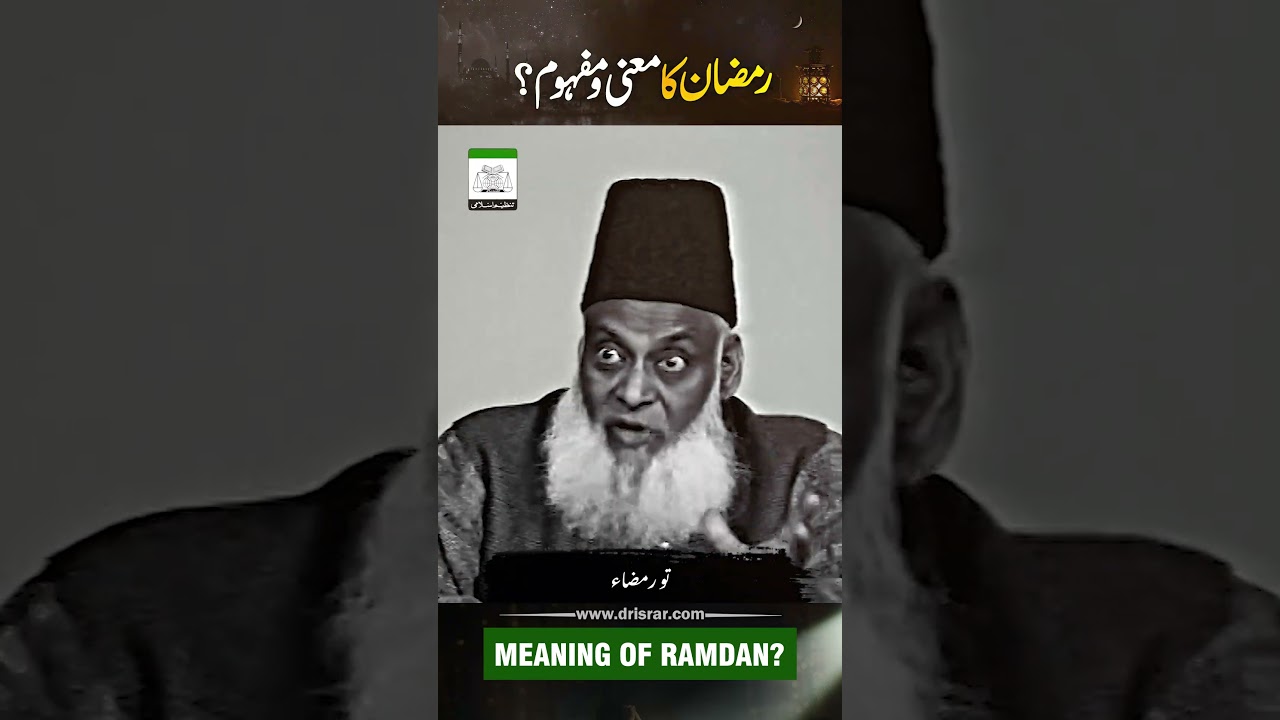
The name Ramadan originates from the intense heat that once prevailed in Arabia, causing hardship and even death. People perceived this time as one where purification occurred naturally. The month of Ramadan was thus associated with cleansing and seen as a period where accumulated impurities within the human body were naturally eliminated. The practice of fasting was ordained by God to facilitate this process. Another interpretation connects the name Ramadan to one of God’s names, signifying ‘the month of God.’ This is supported by a tradition of the Prophet Muhammad, who identified Sha’ban as his month and Ramadan as God’s month.
57
