Şort

A traveler lost in the desert, deprived of his camel, water, and provisions, despairs until, through divine intervention, his camel reappears. Overjoyed, he momentarily forgets his place before God, exclaiming God is his servant. This prompts a reflection on the immense joy God feels when a servant repents, exceeding the joy the servant experiences upon receiving a blessing. The story emphasizes God’s boundless mercy and the importance of humility.

53

The human soul inherently possesses two crucial elements: divine knowledge ('ma'rifat-e-Rabbani') and divine love ('mohabbat-e-Rabbani'). These are present as a radiant light and inner warmth, often obscured by layers of heedlessness, desire, ego, and pride. These obscuring layers deepen with increased indulgence in worldly desires or the development of arrogance, concealing the soul's innate connection to the divine. Removing these layers reveals the glowing ember of spiritual awareness and affection already within.
50
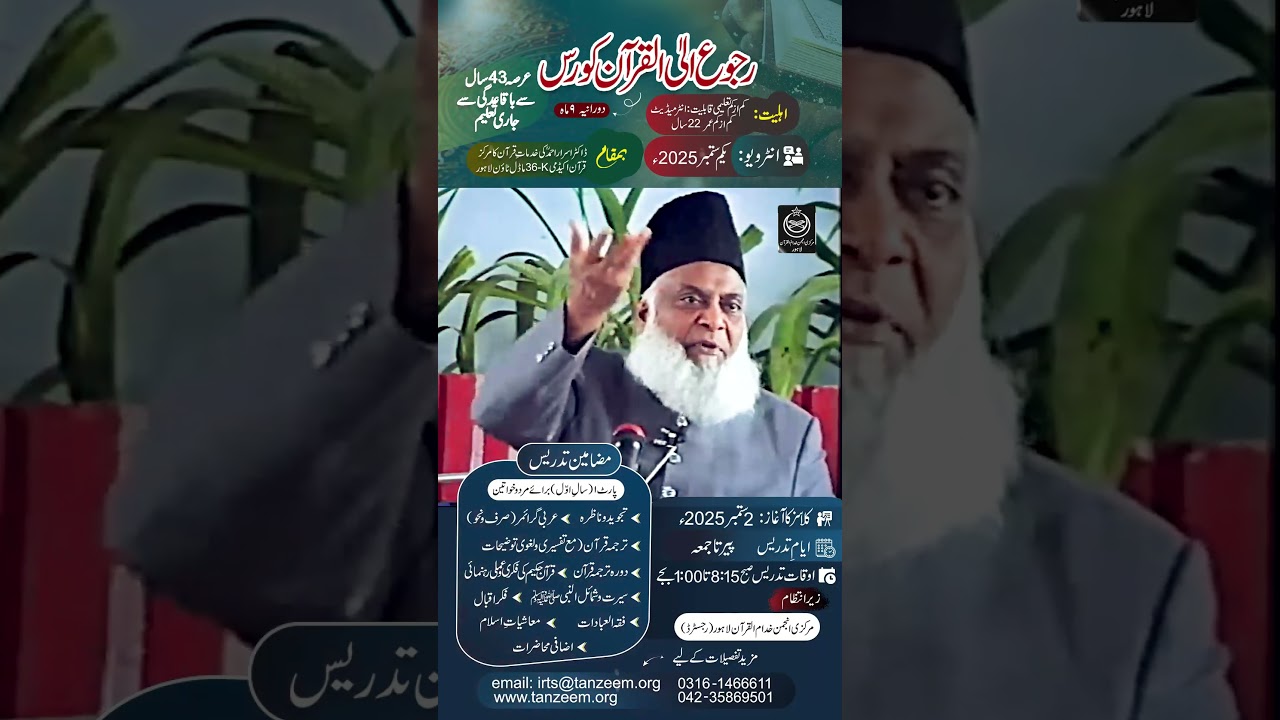
This lecture emphasizes the necessity of personal repentance (tawbah) and its expansion into a collective movement. It urges listeners to prioritize learning Arabic to properly understand and convey the Quran, as the primary medium for inviting others to the faith. The speaker stresses the urgency of life, the potential for unforeseen circumstances, and the importance of dedicating time to religious education and the preparation of a dedicated group (da'i) committed to spreading the message of Islam. He shares his life's dedication to Quranic study, teaching, and the organization of a committed group, viewing this as a vital struggle for the faith. The ultimate goal is the growth of a movement devoted to upholding and propagating Islamic principles.
58

The lecture details the immense hardship faced by the Prophet Muhammad (peace be upon him) during the Year of Taif, considered the greatest personal trial. It then discusses the Battle of Uhud as the greatest collective trial for the companions. Following these trials, enhanced protection was granted to the Prophet. The year also marked the beginning of conversions to Islam, with six accepting faith during Hajj, twelve the following year, and seventy-two thereafter. This led to the Pledge of Aqabah and the opening of the path for migration, ultimately leading to triumph and success.
50

This lecture explains that on the Day of Judgement, a manifestation of Allah will occur, but only those with faith will be granted this divine vision. The Quran states that disbelievers will be veiled on that day, unable to witness this manifestation reserved for the believers. This vision is a special blessing for the faithful, inaccessible to those who rejected faith.
46

This lecture details three categories of people whose prayers are not accepted by God. These include a man who remains with a wife of bad character but refuses divorce, an individual who entrusts wealth to a foolish person despite divine prohibition, and a person who has a debt outstanding but did not establish proper witnesses. God will not answer the prayers of such individuals.
45
