Celana pendek

This lecture discusses the inevitable trials and tribulations faced by believers. It explains that hardship and adversity are not punishments, but rather tests of faith designed to distinguish those genuinely committed to their beliefs from those who are not. True believers willingly sacrifice their lives and possessions for the promise of Paradise. These trials—fear, hunger, loss of wealth, and life—are the price of admission to eternal reward. Those who persevere through these difficulties demonstrate their sincerity and earn their place in Paradise. The lecture emphasizes that genuine faith requires a willingness to endure hardship for the sake of God.

40
Historically, the prevailing scientific understanding, rooted in Newtonian physics, posited an eternal and indestructible universe. However, modern physics has established that the universe had a definite beginning, known as the Big Bang. This event, occurring billions of years ago, marked the creation of the universe from an extremely dense and hot state. This represents a fundamental shift in cosmological understanding.
58
Islam’s core principle is the absolute oneness of God (Tauheed). All forms of goodness, righteousness, and guidance stem from this central belief, representing branches, leaves, and blossoms of a blessed tree. Conversely, evil, sin, and error—whether in belief, thought, or action—are rooted in *shirk*—associating partners with God—and represent the branches of a poisonous tree. Every negative element, in any form, ultimately connects back to this fundamental deviation from pure monotheism.
35

This lecture clarifies that the ultimate abode, the Hereafter, is reserved for those who abstain from seeking power, dominance, or causing corruption on Earth. It emphasizes that this eternal reward is specifically for the righteous—those who prioritize piety and abstain from worldly ambitions. The lecture highlights the promise of lasting peace, prosperity, and fulfillment in the Hereafter for those who live a life of devotion and righteousness, and that ultimate success and well-being are reserved for the God-conscious.
40
This lecture explores the dual nature of *dawat* (invitation) and *tabligh* (propagation). It clarifies that both involve conveying a message and guiding someone toward a particular path. *Dawat* focuses on reaching out and delivering the message, while *tabligh* emphasizes bringing someone along that path, accepting the invitation. The lecture highlights that these are not separate actions, but two sides of the same effort—communicating a message and encouraging acceptance. The speaker emphasizes the importance of conveying the message and guiding others towards righteousness.
51
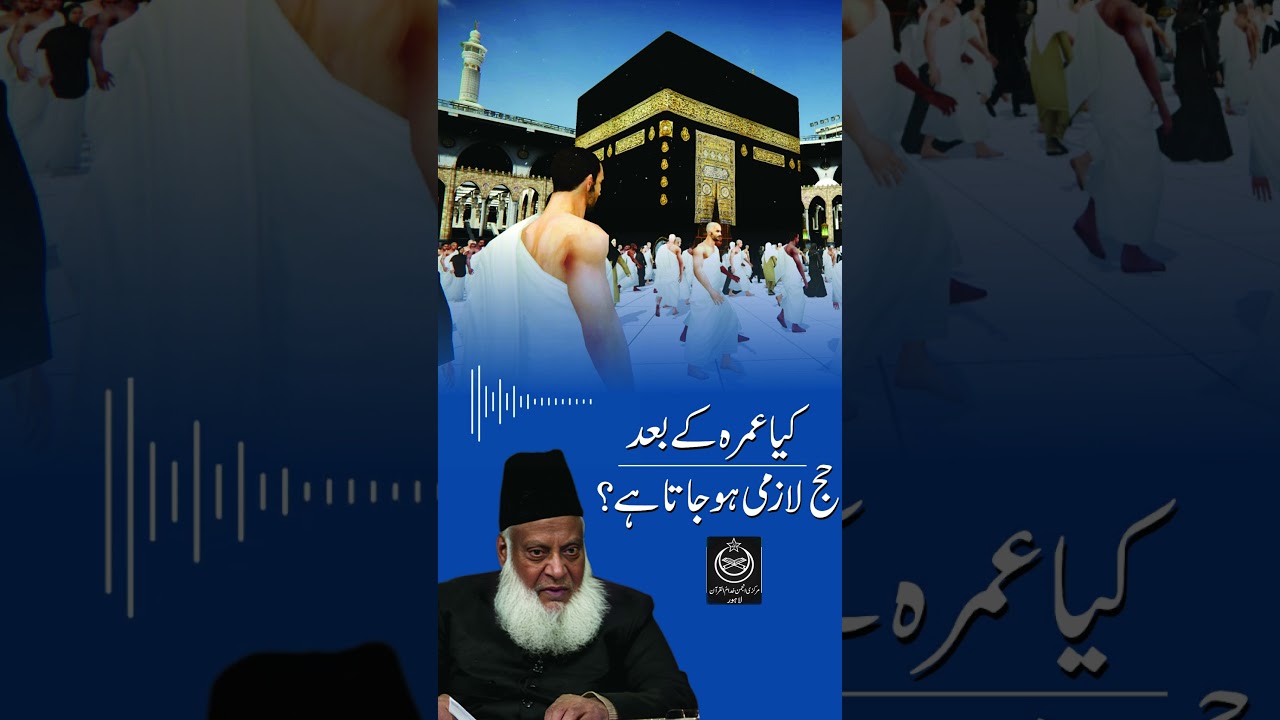
This lecture clarifies whether performing Umrah necessitates performing Hajj. It addresses the scenario of someone performing Umrah while on official government travel, funded by the state, and lacking the financial means for Hajj. The core point is that Umrah itself does not automatically make Hajj obligatory. However, if an individual possesses the financial capability, they should prioritize fulfilling the obligatory Hajj pilgrimage. The lecture emphasizes that if someone can afford to perform Hajj, it becomes an obligation upon them.
71
