شلوار کوتاه

This lecture discusses the inevitable trials and tribulations faced by believers. It explains that hardship and adversity are not punishments, but rather tests of faith designed to distinguish those genuinely committed to their beliefs from those who are not. True believers willingly sacrifice their lives and possessions for the promise of Paradise. These trials—fear, hunger, loss of wealth, and life—are the price of admission to eternal reward. Those who persevere through these difficulties demonstrate their sincerity and earn their place in Paradise. The lecture emphasizes that genuine faith requires a willingness to endure hardship for the sake of God.

40
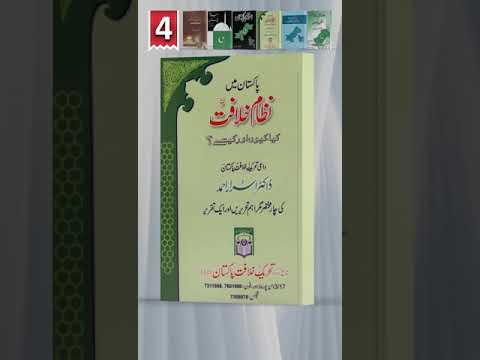
This collection of lectures by Dr. Israr Ahmad addresses critical questions about Pakistan’s history, ideology, and future. Topics include the legacy of the founder of Tanzeem-e-Islami, the viability of a caliphate system, the historical and political context of Islam in Pakistan, the factors contributing to Pakistan’s instability, and the reality of the Pakistan Ideology. The set also features Dr. Ahmad's analysis of Pakistan's political landscape from 1977 to 1987. Available for ₨1200 (originally ₨1900) from Maktaba Khuddam-ul-Quran, Lahore. Home delivery is free with cash on delivery. Order online at www.maktaba.com.pk or WhatsApp at 0301-1115348.
53

This lecture emphasizes that voting is an act of entrusting responsibility, akin to appointing a trustworthy advisor. Voters should prioritize competence, integrity, and suitability when selecting representatives at all levels—from local officials to national leaders. The speaker cautions against prioritizing personal connections, nepotism, or self-interest. The selection process must ensure that chosen individuals are truly capable of serving the nation, community, and wider collective, upholding principles of justice and competence in governance. The ultimate goal is to establish an organization built on merit and dedicated to selfless service.
44
This lecture clarifies the obligation to make up missed fasts (qaza) due to illness or other valid reasons. It distinguishes between those who are medically unable to fast and those who are capable, emphasizing that healthy individuals must fulfill their obligation by fasting. The discussion also covers the permissible form of compensation (fidyah) for those with permanent, incurable illnesses or conditions where fasting poses a significant health risk. It details that providing a meal to a needy person can serve as fidyah in specific cases, but is not a substitute for fasting when one is able.
119
Many misconceptions exist regarding remembrance of Allah. A primary error is conflating *zikr* itself with the *means* of remembrance. *Zikr* is the presence of Allah in the heart – maintaining awareness, love, and connection with Him. Reciting phrases like “Subhan Allah” is a *means* to *zikr*, but not *zikr* itself. If one’s mind is preoccupied with worldly problems while reciting, the *means* is employed, but the true *zikr* – the presence of Allah in the heart – is not achieved. Similarly, prayer is a *means* to *zikr*; the ultimate goal is the presence of Allah within the heart.
87

Imam Ahmad ibn Hanbal narrates a tradition from Maqdad ibn al-Aswad, a companion of the Prophet Muhammad (peace be upon him). During a consultation before the Battle of Badr, Maqdad declared that they were not like the companions of Moses who hesitated to fight, but were followers of Muhammad, ready to obey his command. The Prophet (peace be upon him) then proclaimed a significant prophecy: no dwelling, whether built of brick or tents, will remain where Islam does not enter, either with the honor of acceptance or the disgrace of rejection. This signifies Islam’s inevitable global spread and triumph.
37
