Kratke hlače
Human beings inherently seek to reassure their conscience, even those seemingly immersed in wrongdoing. This lecture explores the universal need to perform some act of goodness, offering a psychological solace amidst a life potentially dominated by negativity. The poet’s verse highlights how a continuous self-deception—finding justification in minor acts while overlooking greater failings—is essential for sustaining life, allowing individuals to cope with their inherent imperfections. The pursuit of goodness, however small, serves as a vital mechanism for maintaining psychological equilibrium.

69

This lecture discusses the recitation of at least three verses of the Quran in each *rak'ah* (prayer cycle) after Surah al-Fatiha, based on the practice and guidance of the Prophet Muhammad (peace be upon him). It highlights that the Quran itself is structured in sections of at least three verses. The lecture specifically references Surah al-Kausar and Surah al-Asr as examples of Quranic sections containing exactly three verses, emphasizing their significance. The speaker explains that this practice ensures complete engagement with the Quran during prayer, aligning with the prophetic tradition.
56
The soul is the center of our existence, distinct from the body. While the body originates from the earth, remains for a time, and ultimately returns to it, the soul is eternal and originates from, and returns to, God. Death involves the separation of the soul from the body; the soul itself does not die but transitions. The act of ‘ قبض’ (taking/receiving) relates to the body, not the soul. The soul’s journey is one of return to its divine source, a concept encapsulated in the phrase ‘Inna lillahi wa ilayhi raji’un.’
63
The central theme of the Quran is faith in the unseen, encompassing knowledge of the metaphysical realm beyond sensory perception. This knowledge, revealed through Muhammad, forms the foundation of true understanding. The Quran provides guidance on both spiritual beliefs and practical life, addressing societal, economic, and personal conduct. It delineates permissible and forbidden actions, offering a comprehensive framework for a balanced and righteous life. This lecture clarifies that the Quran’s core message isn't simply a list of do's and don'ts, but a holistic system of belief and practice.
55
This lecture discusses the Islamic perspective on charitable giving and the rights of heirs. A companion of the Prophet Muhammad (peace be upon him) inquired about donating all his wealth for the sake of Allah. The Prophet advised against leaving heirs destitute, emphasizing their rightful share. The companion then proposed donating half, then a third, with the Prophet accepting the one-third contribution as appropriate. This highlights a balanced approach to charity, respecting both the act of giving and the welfare of one’s family.
64
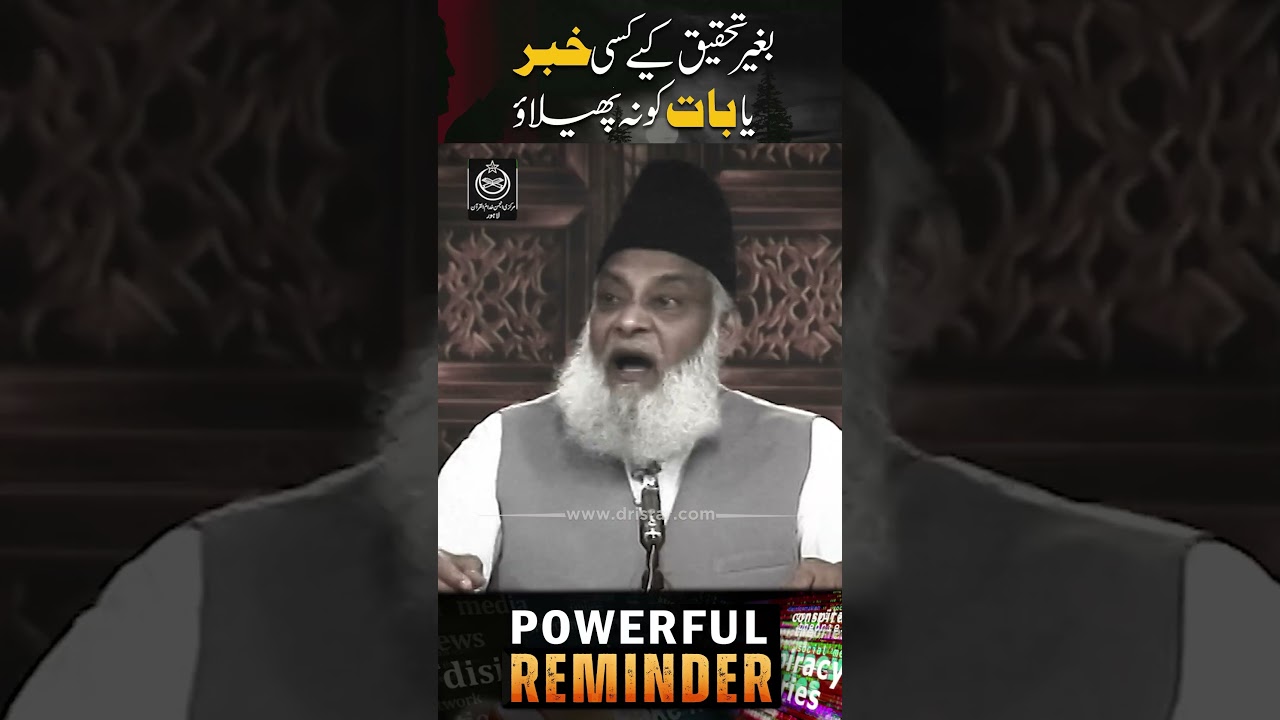
This lecture emphasizes the severity of spreading unverified information. Simply repeating what one hears without investigation constitutes a form of falsehood, even without malicious intent. The speaker stresses the importance of verifying information before sharing it, as relaying unconfirmed news contributes to the spread of lies. Repeating hearsay, even without intending to deceive, makes one complicit in the dissemination of falsehoods. The lecture advocates for careful consideration and verification before speaking.
64
