শর্টস
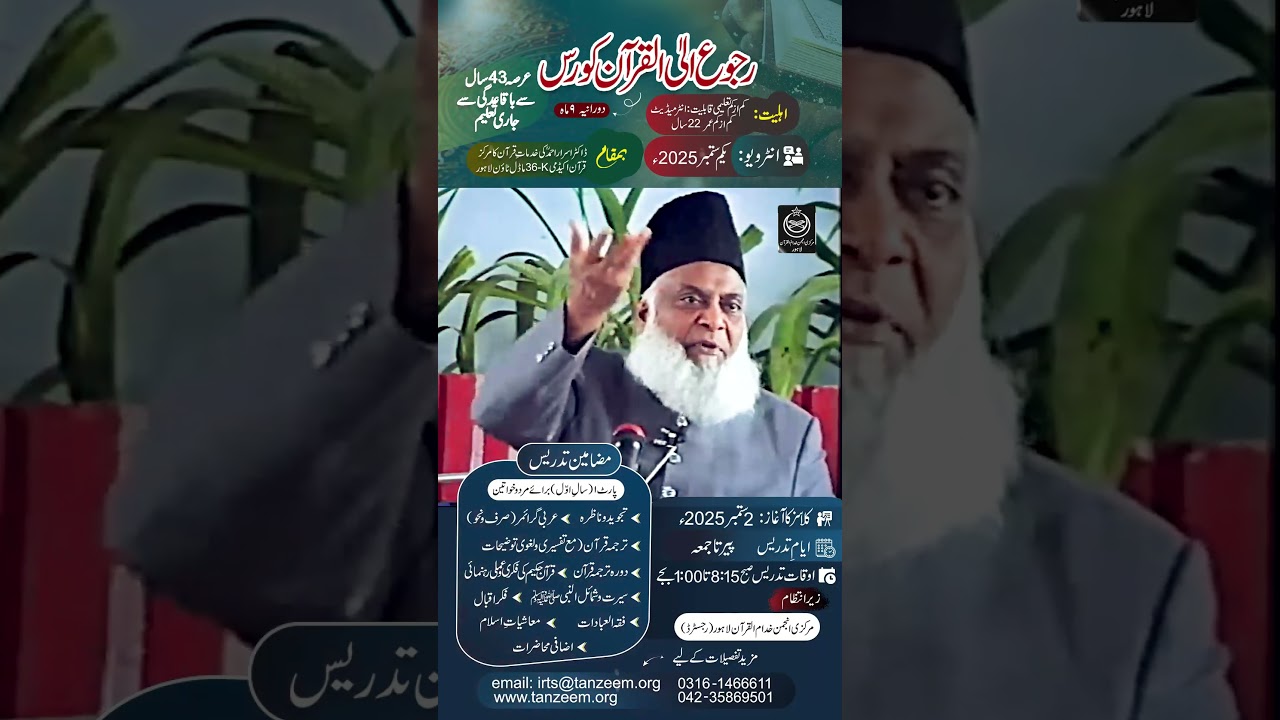
This lecture emphasizes the necessity of personal repentance (tawbah) and its expansion into a collective movement. It urges listeners to prioritize learning Arabic to properly understand and convey the Quran, as the primary medium for inviting others to the faith. The speaker stresses the urgency of life, the potential for unforeseen circumstances, and the importance of dedicating time to religious education and the preparation of a dedicated group (da'i) committed to spreading the message of Islam. He shares his life's dedication to Quranic study, teaching, and the organization of a committed group, viewing this as a vital struggle for the faith. The ultimate goal is the growth of a movement devoted to upholding and propagating Islamic principles.

62
Hadrat Jaber ibn Abdullah states that a believer in God and the Day of Judgement should never be alone with a non-mahram woman. Any meeting should occur in the presence of a mahram (close male relative). This principle applies to both meetings and travel. The Prophet Muhammad (peace be upon him) emphasized that when a man and a non-mahram woman are alone, a third party – Shaytan – is present. Hadrat Ibn Abbas narrates a similar instruction: a man should not be alone with a woman unless a mahram accompanies her, and a woman should not travel without a mahram.
64

This lecture discusses the two central acts of worship in Ramadan: fasting during the day and standing in prayer (Tahajjud) at night. Fasting is obligatory, while Tahajjud, although highly encouraged and rewarded, is not compulsory. The speaker explains that while the Prophet Muhammad (peace be upon him) observed Tahajjud as a regular practice akin to an obligation, it remains optional for the general Muslim population. Those who perform Tahajjud will receive a high status with Allah. The emphasis is on voluntary devotion and the blessings within Ramadan’s nights.
67
This lecture explains that true migration (Hijrat) isn’t necessarily physical relocation, but rather abandoning disobedience and striving for obedience to God. It's a continuous internal struggle (Jihad) against base desires and harmful habits. The most superior migration is renouncing everything displeasing to God, even while remaining in one’s home and among family. This internal shift, a detachment from the prohibited, constitutes genuine Hijrat.
68
Mawla Rumi compares the human self to Pharaoh, highlighting its potential for arrogance and self-deification. While Pharaoh possessed power and proclaimed divinity, the human self often harbors similar inclinations internally, lacking external force but maintaining an internal sense of dominion. True struggle, as emphasized by the Prophet Muhammad (peace be upon him), lies in conquering this inner enemy – the self. This internal jihad, the struggle against one's desires and ego, is the foundation for all other righteous endeavors and the path to becoming a true servant of God.
71

True piety (taqwa) isn't about outward appearances or rituals, but an internal state of consciousness and unwavering faith. It’s a complete immersion of one's personality in the principles of divine guidance. Genuine piety manifests as a consistent effort to please God and avoid disobedience, permeating the entire being with a distinct spiritual color. It resides in the heart and is intrinsically linked to faith. The Prophet Muhammad (peace be upon him) repeatedly pointed to his chest to emphasize that piety dwells within the heart, not in external displays.
41
