شارٹس
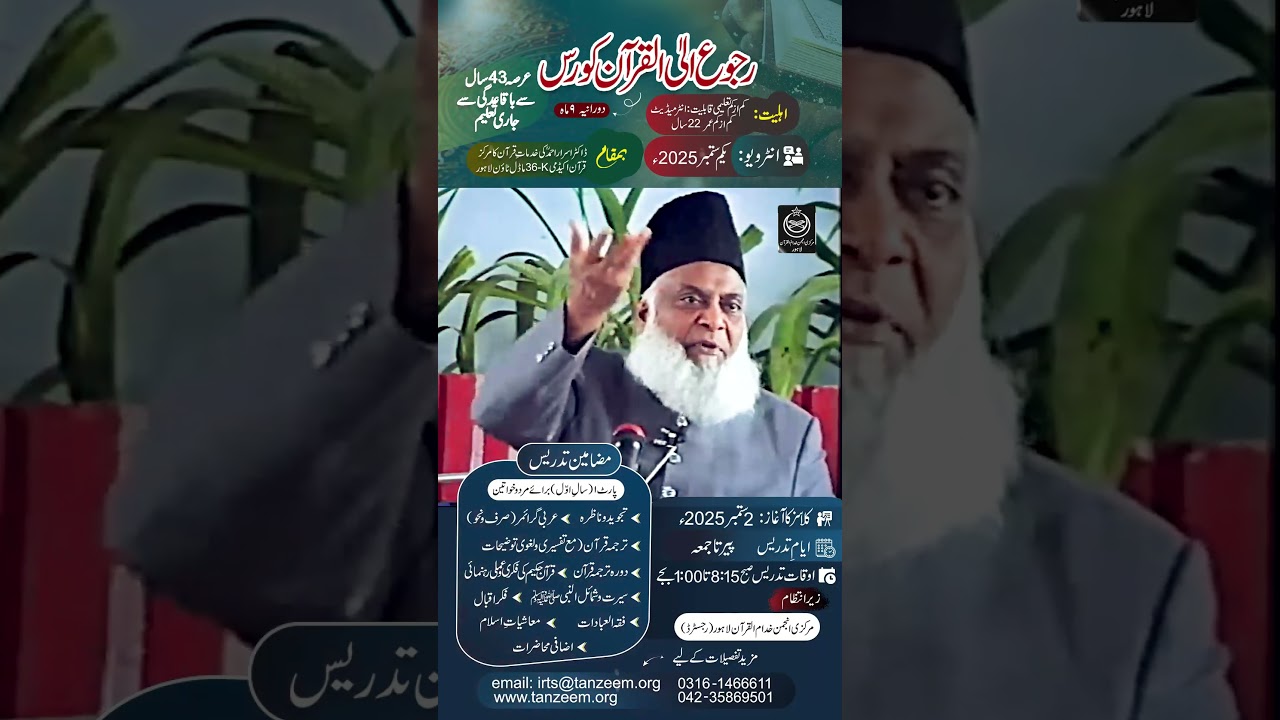
This lecture emphasizes the necessity of personal repentance (tawbah) and its expansion into a collective movement. It urges listeners to prioritize learning Arabic to properly understand and convey the Quran, as the primary medium for inviting others to the faith. The speaker stresses the urgency of life, the potential for unforeseen circumstances, and the importance of dedicating time to religious education and the preparation of a dedicated group (da'i) committed to spreading the message of Islam. He shares his life's dedication to Quranic study, teaching, and the organization of a committed group, viewing this as a vital struggle for the faith. The ultimate goal is the growth of a movement devoted to upholding and propagating Islamic principles.

62

Islam’s core principle is the absolute oneness of God (Tauheed). All forms of goodness, righteousness, and guidance stem from this central belief, representing branches, leaves, and blossoms of a blessed tree. Conversely, evil, sin, and error—whether in belief, thought, or action—are rooted in *shirk*—associating partners with God—and represent the branches of a poisonous tree. Every negative element, in any form, ultimately connects back to this fundamental deviation from pure monotheism.
42

This lecture explores the concept of existence prior to the Big Bang, positing a pre-existing state beyond scientific comprehension. It details the creation of human souls and angels before the material universe, asserting their non-material nature and timeless existence. The lecture explains that all souls—from Adam to the last human before the Day of Judgment—were created in this pre-Big Bang realm, existing outside the confines of the material universe and time itself. This pre-existence is presented as a foundational element of Islamic cosmology.
51

The Quran’s compilation involved both a chronological (نزولی) and the current (مصحف) arrangement. The earliest verses revealed were from Surah Al-Alaq, followed by Surah Al-Qalam, parts of Surah Al-Muzzammil, Surah Al-Mudaththir, and then Surah Al-Fatiha. The current arrangement begins with Surah Al-Fatiha, followed by Surah Al-Baqarah, revealed in Medina. The Prophet Muhammad (peace be upon him) guided the scribes in arranging the verses as they were revealed, ensuring the final compilation was also divinely guided. This process of arrangement and compilation was a divine act, directed by God through His Messenger.
84

Extravagance is a grave sin, defined as spending beyond necessity. Basic needs like food and clothing are sufficient; excessive consumption is wasteful. The text condemns the lavish spending on weddings and displays of wealth motivated by vanity. It draws a parallel between those who squander their resources and the companions of Satan, emphasizing that wasteful spending is a characteristic of those who stray from righteous conduct. The core message is to avoid extravagance and prioritize responsible use of wealth.
67

This lecture clarifies the misconception surrounding collective repentance. True repentance begins with individual introspection and sincere regret. A significant shift in societal norms occurs only when enough individuals genuinely repent and strive to reform the system. Mass gatherings alone, like those during Hajj, do not guarantee systemic change if not coupled with personal transformation. The speaker emphasizes that merely performing rituals without inner renewal yields no lasting impact. The current system, riddled with usury and irreligious practices, necessitates individual repentance as a starting point for broader societal reform. The speaker explains that large gatherings without true repentance will not yield any changes.
61
