Kurze Hose
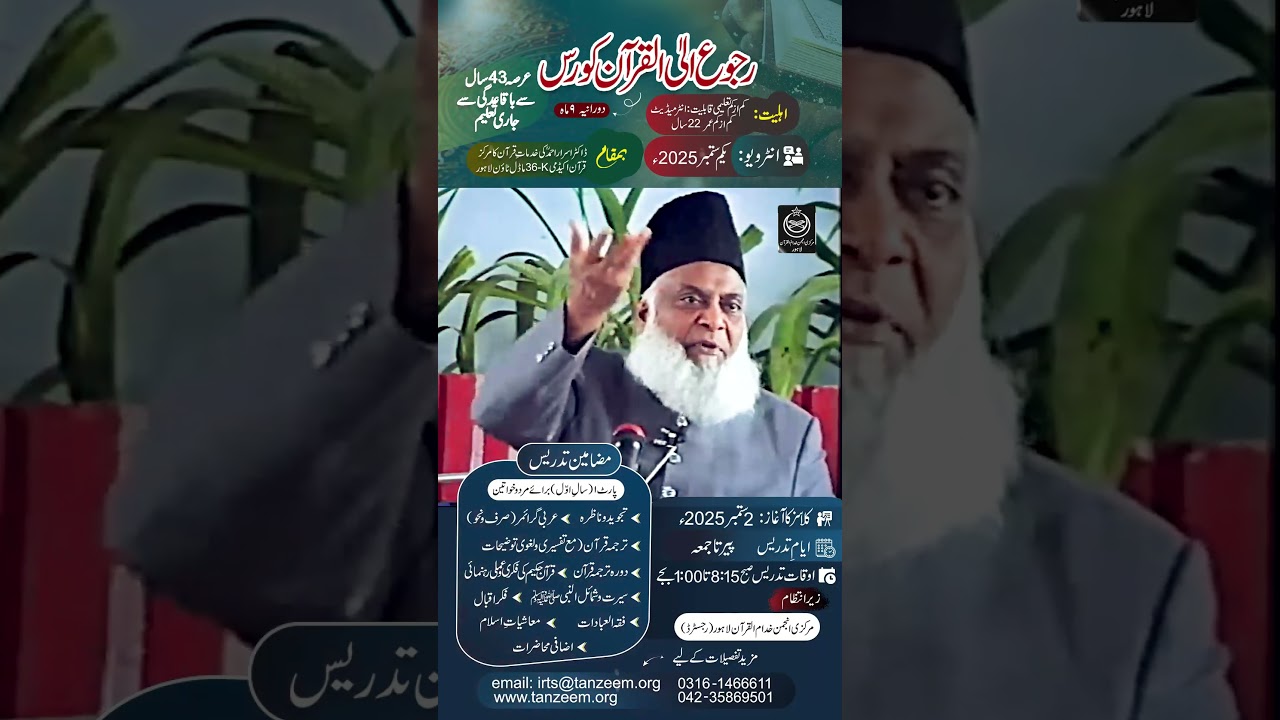
This lecture emphasizes the necessity of personal repentance (tawbah) and its expansion into a collective movement. It urges listeners to prioritize learning Arabic to properly understand and convey the Quran, as the primary medium for inviting others to the faith. The speaker stresses the urgency of life, the potential for unforeseen circumstances, and the importance of dedicating time to religious education and the preparation of a dedicated group (da'i) committed to spreading the message of Islam. He shares his life's dedication to Quranic study, teaching, and the organization of a committed group, viewing this as a vital struggle for the faith. The ultimate goal is the growth of a movement devoted to upholding and propagating Islamic principles.

62

This lecture discusses the story of Adam (peace be upon him) and his repentance after disobeying Allah's command. It highlights the acceptance of his repentance and the subsequent decree that Earth is his domain and that of his descendants. The lecture emphasizes the importance of following divine guidance when it is revealed, and the consequences of rejecting it. It explains that Adam’s progeny are tasked with upholding this divine trust and that accepting guidance leads to security and salvation. The core message centers on forgiveness, the purpose of human life on Earth, and the perpetual need to seek and adhere to divine direction.
54

The Quran possesses two levels of understanding. The first is a surface-level comprehension, readily accessible like oil floating on water after a tanker leak. This represents the primary lessons and wisdom directly present within the text. The deeper level, however, is immeasurable, akin to the depths of the ocean, requiring profound exploration to fully grasp its complexities. Just as measuring the ocean's depths is a challenge, so too is comprehending the full extent of the Quran’s wisdom.
40
The lecture discusses the origins of Islam, emphasizing its initial state of being foreign and unfamiliar. It highlights how Allah granted Islam dominance and power, but warns of a potential return to its original state of isolation if individuals distance themselves from its principles. The speaker congratulates those who remain connected to Islam, despite facing potential alienation and lack of support from their surroundings. The message underscores the importance of remaining steadfast in faith to avoid becoming outcasts.
56
A nation claims to believe in God, the Prophet, the Quran, and Sharia, yet fails to fully implement it. Partial adherence is deemed worse than outright rejection. The Quran, specifically Surah Baqarah verse 85, warns that selective acceptance of divine law leads to severe punishment. Those who choose this path face disgrace in this world and intense torment on the Day of Judgment. This lecture emphasizes the necessity of complete submission to the entirety of Sharia for true faith and salvation.
57

Dr. Israr Ahmad discusses the creation of Jinn and Adam, highlighting their distinct compositions and the source of their creation. He explains that Jinn were created from smokeless fire, while Adam was created from clay. This difference in origin accounts for the superiority of Adam, as he was imbued with the divine spirit (Ruh Muhammadi) that Jinn lacked. The lecture emphasizes that Adam’s creation involved a spiritual dimension absent in the Jinn, making him a more complete and worthy creation. The speaker argues that the Jinn's inferior nature stems from this lack of spiritual essence.
61
