Corti

To achieve any goal, one must control their base instincts and desires. Without self-discipline, life is reduced to a mere animalistic existence. A true human is defined by purpose, striving, hard work, sacrifice, and enduring hardship. Those who live without a defined purpose simply have life pass them by, falling below even the level of animals. The Quran, in Surah A'raf, compares such individuals to livestock, and even worse, as animals are created for a specific purpose, while these individuals squander their human potential.

59
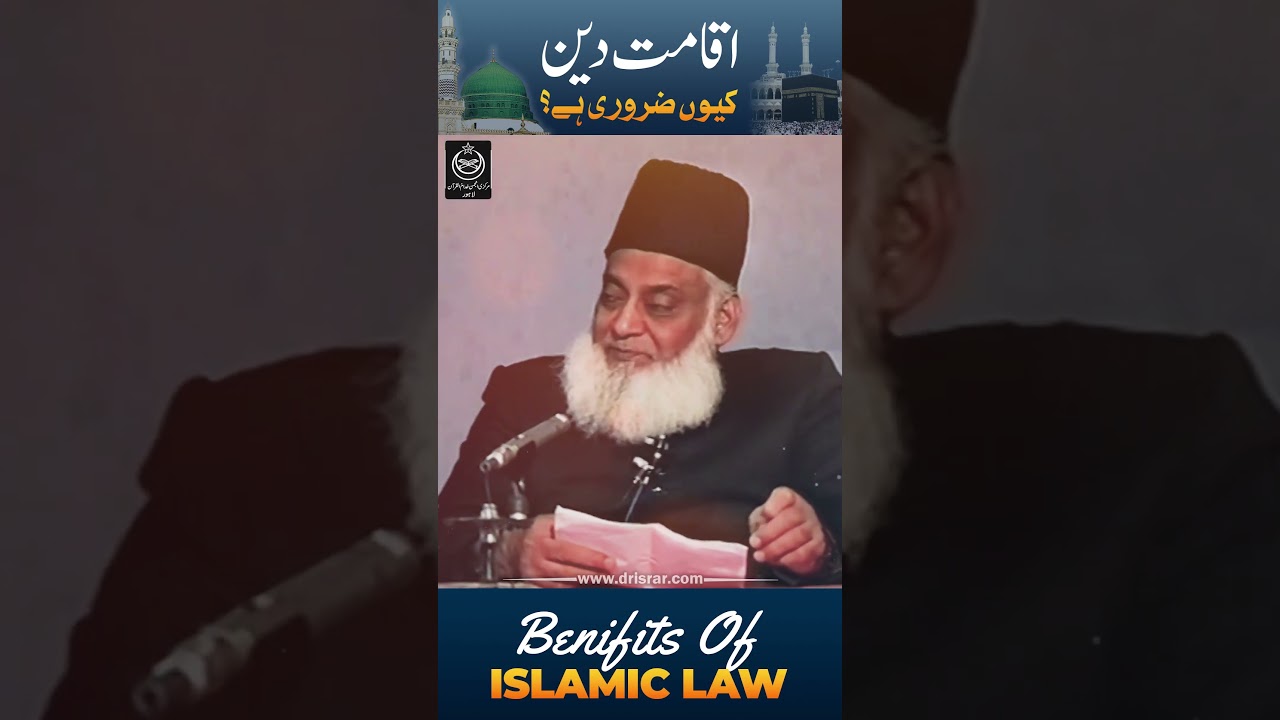
This lecture emphasizes the necessity of establishing a complete Islamic system of life, ensuring that divine law governs all aspects of society, including the legal and parliamentary systems. It argues that adherence to the Quran and the teachings of the Prophet Muhammad is crucial for societal well-being and that neglecting these principles leads to spiritual and societal decline. The speaker stresses that Islam is intended to be a dominant force for good, not to be subjugated, and highlights the importance of unwavering commitment to its principles, even in the face of opposition. The discussion also addresses the historical context of divine scriptures and the consequences of deviating from them.
52

The Prophet Muhammad (peace be upon him) stated that a person who sincerely repents for their sins is as if they never committed them. This highlights that faith and sin are not mutually exclusive; believers will inevitably err. However, genuine repentance immediately restores faith. If a believer commits a sin, their faith temporarily diminishes, but repentance returns it to its rightful place in the heart. Failure to repent results in a permanent loss of faith. The lecture emphasizes that various approaches and analogies are used to convey this vital truth.
38

Dr. Israr Ahmad discusses the profound period Prophet Muhammad (peace be upon him) spent in the Cave of Hira. He highlights the intense contemplation and spiritual journey undertaken by the Prophet before receiving revelation. The lecture details the Prophet’s questioning of existing beliefs, his rejection of idolatry prevalent in his time, and his search for the true God. It emphasizes that this period of solitude and reflection was crucial in shaping his mission and preparing him for prophethood. The discussion also touches upon the Prophet's inherent inclination towards monotheism and his rejection of the worship practices of Jews and Christians.
85

Many misconceptions exist regarding remembrance of God. A primary error is conflating *zikr* (remembrance) with the *means* of remembrance. *Zikr* is the presence of God within the heart – maintaining a connection through remembrance, love, and attachment. Simply repeating phrases like “Subhan Allah” is a *means* of remembrance, but not *zikr* itself. True *zikr* requires focused attention and presence; if the mind is preoccupied with worldly concerns while reciting, the benefit of remembrance is lost. The act itself is a tool; the connection with God is the essence.
39

This lecture explores the concept of attributing both good and evil to Allah, emphasizing the importance of acknowledging mistakes and seeking forgiveness. It clarifies that while humans are prone to error, attributing good deeds to divine guidance and accepting responsibility for misdeeds is crucial. The speaker highlights the necessity of repentance (tawbah) and understanding that true guidance comes from Allah alone. The discussion also touches upon the temptation and subsequent justification of wrongdoing, illustrating the deceptive nature of Shaytan and the importance of self-accountability. Ultimately, the lecture emphasizes that sincere repentance and reliance on Allah’s mercy are essential for spiritual growth.
51
