Shorts

True piety (taqwa) isn't about outward appearances or rituals, but an internal state of consciousness and unwavering faith. It’s a complete immersion of one's personality in the principles of divine guidance. Genuine piety manifests as a consistent effort to please God and avoid disobedience, permeating the entire being with a distinct spiritual color. It resides in the heart and is intrinsically linked to faith. The Prophet Muhammad (peace be upon him) repeatedly pointed to his chest to emphasize that piety dwells within the heart, not in external displays.

37

This lecture details the four characteristics that define a complete hypocrite, and the presence of even one of these traits indicates a degree of hypocrisy. These characteristics are: disloyalty when entrusted, lying when speaking, breaking promises, and losing control during disputes, escalating to abusive language and physical aggression. The speaker explains that true conflict resolution requires self-control and adherence to truthfulness, while the traits of a hypocrite lead to societal breakdown and discord. The lecture emphasizes that even a small amount of hypocrisy can be damaging and requires immediate self-correction.
58

The concept of *ubudiyat* (devotion) encompasses two essential elements: the utmost love and complete submission. True devotion is achieved when both reach their peak, uniting in a profound connection with the Divine. This lecture emphasizes that devotion is fundamentally rooted in intense love for God, coupled with total surrender and humility before Him. These two aspects are inextricably linked; one cannot exist without the other. The complete yielding of self, and an absolute devotion, are the hallmarks of genuine worship.
42
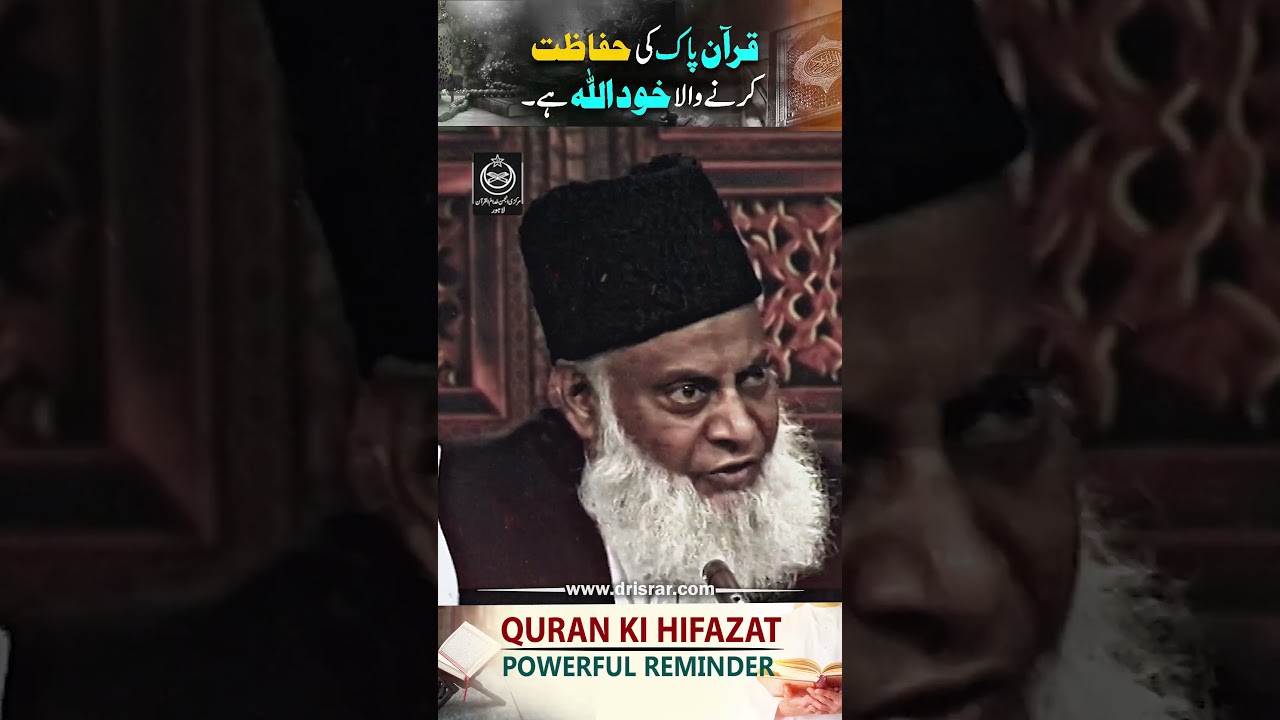
This lecture explores the divine protection of scriptures. It questions why, if God protected the Torah and Gospel, alterations still occurred. The argument centers on the unique preservation of the Quran, asserting that human intervention cannot corrupt its original form. The Quran's protection is explicitly stated in scripture, contrasting with the perceived lack of such protection for previous texts. Human translations and interpretations are acknowledged as sources of potential distortion, while the Quran itself remains inviolable.
35
Surah Al-Asr is among the shortest chapters of the Quran, consisting of only three verses. It is also among the earliest revealed chapters. The Quranic style, as described in Surah Hud, is to first establish firm principles and then elaborate upon them, originating from the All-Wise, All-Knowing. This lecture by Dr. Israr Ahmad explores the significance of Surah Al-Asr and its message of time, loss, and the importance of faith and righteous deeds.
58

This lecture discusses the underlying unity of the African continent, despite its diverse cultures, languages, and physical appearances. The speaker highlights a shared spiritual resonance, symbolized by the continuous recitation of ‘Labbaik Allahumma Labbaik’ during pilgrimage, indicating a common faith and devotion. The continuous arrival of pilgrim groups exemplifies this widespread spiritual connection, creating a powerful, unifying presence across the land. The lecture emphasizes that this spiritual unity transcends geographical and cultural boundaries.
49
