Calção
True piety (taqwa) isn't about outward appearances or rituals, but an internal state of consciousness and unwavering faith. It’s a complete immersion of one's personality in the principles of divine guidance. Genuine piety manifests as a consistent effort to please God and avoid disobedience, permeating the entire being with a distinct spiritual color. It resides in the heart and is intrinsically linked to faith. The Prophet Muhammad (peace be upon him) repeatedly pointed to his chest to emphasize that piety dwells within the heart, not in external displays.

37
This lecture explores the life of Prophet Muhammad (peace be upon him) as a comprehensive model for life, emphasizing the struggles and sacrifices made to establish Islam. It highlights the importance of not just following superficial rituals, but embodying the spirit of striving for the dominance of God's religion in all aspects of life. The speaker stresses the need for individual and collective effort, drawing parallels between the Prophet's challenges and the current state of the Muslim community. True devotion lies in aligning one's actions with the Prophet's example, not merely reciting slogans or claiming piety. It’s a call to emulate the Prophet’s relentless dedication to establishing justice, truth, and faith in the world.
83
This lecture clarifies the obligation to make up missed fasts (qaza) due to illness or other valid reasons. It distinguishes between those who are medically unable to fast and those who are capable, emphasizing that healthy individuals must fulfill their obligation by fasting. The discussion also covers the permissible form of compensation (fidyah) for those with permanent, incurable illnesses or conditions where fasting poses a significant health risk. It details that providing a meal to a needy person can serve as fidyah in specific cases, but is not a substitute for fasting when one is able.
119
This lecture emphasizes the religious obligation of every Muslim to strive for the establishment of the Caliphate system. It asserts that failing to do so constitutes a contradiction of faith and a disregard for divine law. The speaker criticizes a narrow focus on material possessions and worldly concerns, arguing that a true Muslim’s life should be dedicated to this essential struggle, regardless of whether their efforts are recognized or accepted by others. The lecture draws a parallel to the tireless work of past prophets, highlighting that persistent effort is key to success, even in the face of rejection.
64
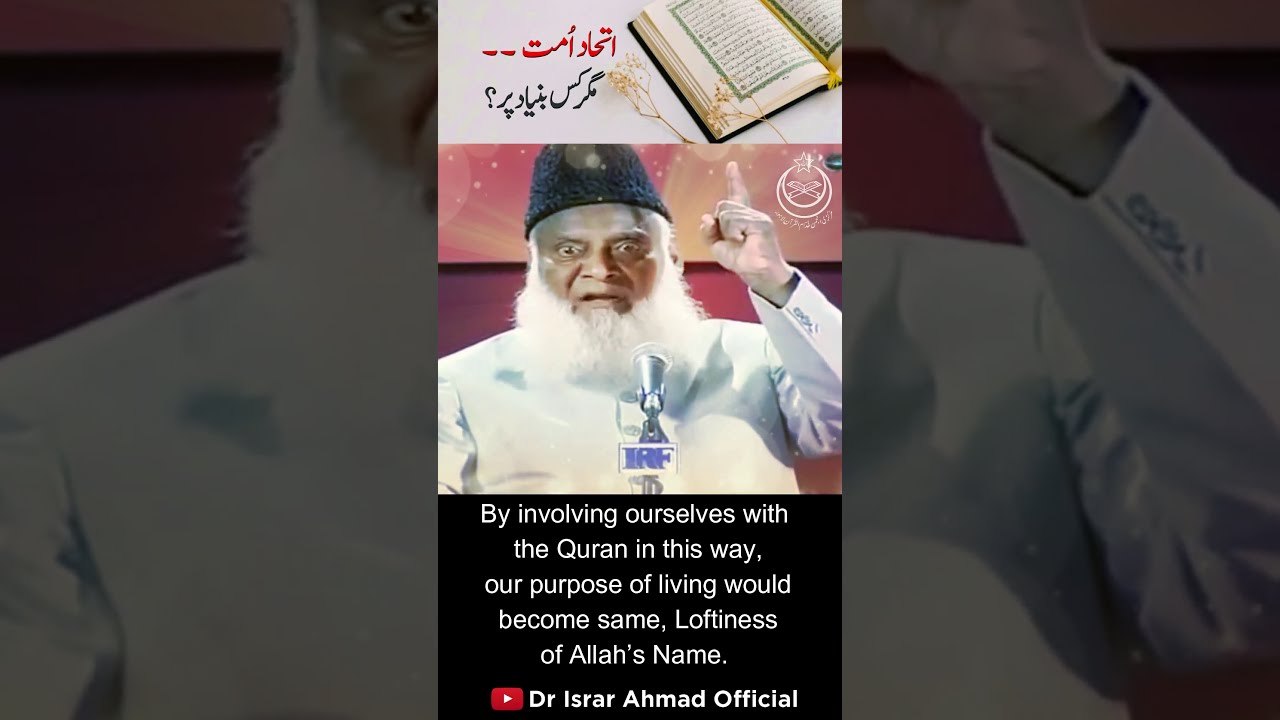
True unity within the Muslim community requires more than just superficial calls for togetherness. It necessitates a fundamental alignment of thought, ideology, objectives, and methodology. Mere gatherings, like a herd of animals, are insufficient. The Quran serves as the sole unifying force, fostering intellectual and ideological harmony not merely through recitation, but through comprehension and mindful study. When individuals share a common purpose – the elevation of the word of God – they truly become a community. This shared objective is the foundation for genuine unity.
67

The speaker asserts that religious morality built upon a foundation lacking inherent ethical character is inherently weak and ineffective. He illustrates this with the example of a local businessman known as Haji Blackia, a wealthy sugar distributor known for his outward religious observance (leading prayers, having a long beard) but lacking genuine moral principles. The speaker argues that superficial religious practice without inner integrity is meaningless and ultimately futile. True religious morality must be rooted in solid ethical character.
55
