Shorts
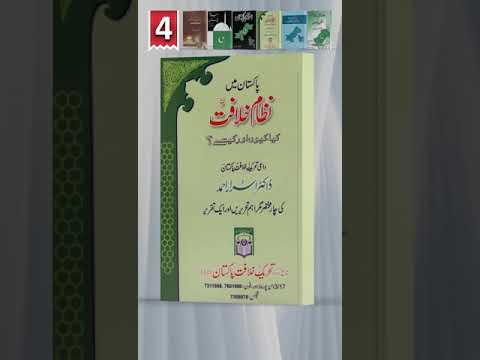
This collection of lectures by Dr. Israr Ahmad addresses critical questions about Pakistan’s history, ideology, and future. Topics include the legacy of the founder of Tanzeem-e-Islami, the viability of a caliphate system, the historical and political context of Islam in Pakistan, the factors contributing to Pakistan’s instability, and the reality of the Pakistan Ideology. The set also features Dr. Ahmad's analysis of Pakistan's political landscape from 1977 to 1987. Available for ₨1200 (originally ₨1900) from Maktaba Khuddam-ul-Quran, Lahore. Home delivery is free with cash on delivery. Order online at www.maktaba.com.pk or WhatsApp at 0301-1115348.

53
This lecture elucidates the inherent truth and ultimate triumph of Islam as a complete way of life. It asserts that God sent His Messenger with guidance and truth to establish a just order, ensuring the dominance of divine law over all other systems. The core message emphasizes that the divine system will prevail, overcoming injustice and establishing a righteous world. The lecture highlights the inevitability of God’s plan for the supremacy of truth and justice, ultimately leading to a world governed by divine principles.
55
Dr. Israr Ahmad discusses the degree to which adopting modern terminology with Islam is permissible or undesirable. He argues for caution regarding new terms, asserting each carries inherent connotations inseparable from its meaning. However, he acknowledges effective communication requires utilizing contemporary language to reach modern audiences, advocating for a balanced approach – using current terminology for conveyance but avoiding rigid adherence to it.
43
This lecture explains the concept of *tasbeeh* – the glorification of God – as inherent in the very fabric of creation. It clarifies that *tasbeeh* isn't limited to verbal recitation but encompasses the perfect and sustained existence of all things, free from imperfection or need. The lecture draws parallels between the act of floating or orbiting – maintaining a fixed course – and the continuous glorification of God by the universe. Every element, from planets to particles, testifies to the Creator’s perfection and power. The universe operates flawlessly, demonstrating divine knowledge, wisdom, and omnipotence. True *tasbeeh* is the silent testimony of creation to its perfect Creator, a being free from all flaws, weakness, and dependence.
55
This lecture clarifies the position of a prophet (Nabi) in Islam. It distinguishes a prophet from other pious individuals by highlighting the unique role of divine revelation (wahy). A prophet's assignment isn't to enforce belief through threats, but to convey the message due to an inherent natural compulsion. The lecture draws a parallel to a civil servant passing an exam and awaiting appointment, explaining that authority and responsibility come with official designation, similar to how a prophet’s role is defined by divine appointment. The core message is that a prophet is primarily a messenger of God, and his guidance is based on conveying the message, not coercion.
46
This lecture discusses the historical and economic benefits of sacrificial meat (Qurbani) in a specific region. It highlights how, traditionally, communities utilized every part of the animal, ensuring no waste. The speaker details how this practice provided a livelihood for local herders and a year-round meat supply for residents. The lecture contrasts this sustainable system with modern practices and argues against claims of wastefulness, emphasizing the economic support Qurbani provided to the community. It describes a time when communities thrived due to the efficient use of resources from the sacrificial animals, providing economic stability for local residents and herders. The lecture points out that Qurbani was not merely a religious ritual but a crucial element of the local economy.
86
