Şort
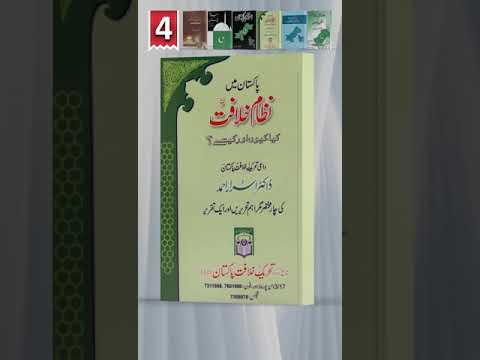
This collection of lectures by Dr. Israr Ahmad addresses critical questions about Pakistan’s history, ideology, and future. Topics include the legacy of the founder of Tanzeem-e-Islami, the viability of a caliphate system, the historical and political context of Islam in Pakistan, the factors contributing to Pakistan’s instability, and the reality of the Pakistan Ideology. The set also features Dr. Ahmad's analysis of Pakistan's political landscape from 1977 to 1987. Available for ₨1200 (originally ₨1900) from Maktaba Khuddam-ul-Quran, Lahore. Home delivery is free with cash on delivery. Order online at www.maktaba.com.pk or WhatsApp at 0301-1115348.

53
This lecture explains that the essence of all divine commands converges on the single concept of *ibadat* (worship). The speaker references the initial verses of Surah Nuh, where Prophet Noah is instructed to warn his people. The core message is to worship God, practice *taqwa* (righteousness), and obey the prophet. This highlights worship as the fundamental purpose of human existence and the means to avert divine punishment. The lecture emphasizes that true worship encompasses both adherence to divine commands and a sincere devotion to God.
55
Human beings possess an inherent understanding of good and evil, stemming from a divinely inspired moral compass embedded within their nature. This internal faculty guides individuals towards righteousness and away from wrongdoing. The core principles of ethical conduct – fulfilling obligations, avoiding prohibited acts like usury and intoxicants, and embracing virtues like prayer and fasting – are foundational to this innate understanding. This inherent moral sense is not learned but rather a natural attribute of the human soul, a divine endowment that distinguishes humanity.
43
This lecture discusses the potential re-establishment of a caliphate rooted in the principles of the Prophet Muhammad, specifically predicting its emergence in Pakistan and Afghanistan following a potential division of Afghanistan and the integration of Pashtun areas with Pakistan. It posits that the Sindh Valley, as envisioned by Iqbal, will become the center of this caliphate, from which forces will operate. The lecture also addresses the Shia belief in the return of the twelfth Imam, who has been in occultation for over a thousand years, and their expectation of his leadership. It suggests this leader will establish a government and raise armies, while highlighting a perceived lack of strength in Arab nations.
60
The Quran outlines four essential conditions for salvation: faith, righteous deeds, adherence to truth, and patience. These components form a complete prescription for spiritual well-being. Removing even one element invalidates the prescription, potentially leading to negative consequences instead of healing. Just as a patient cannot alter a doctor’s prescribed medication and expect positive results, one must fully embrace these four conditions to achieve salvation. These four elements constitute a complete prescription from God for spiritual healing and success.
51
We live under the illusion of possessing faith when, in reality, we hold mere beliefs passed down through generations, a bundle of inherited convictions stored within our communities. True faith, or *iman*, is characterized by certain knowledge—knowledge of certainty, experiential certainty, and the certainty of truth. This certainty is a connection, a realization of being observed by God, a presence felt deeply. It encompasses belief in life after death, in Paradise and Hell, and the fundamental truth that true life resides in the afterlife.
52
