Celana pendek
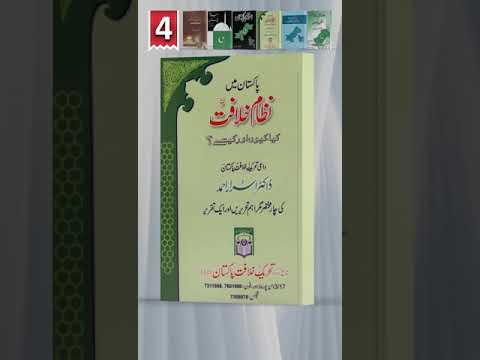
This collection of lectures by Dr. Israr Ahmad addresses critical questions about Pakistan’s history, ideology, and future. Topics include the legacy of the founder of Tanzeem-e-Islami, the viability of a caliphate system, the historical and political context of Islam in Pakistan, the factors contributing to Pakistan’s instability, and the reality of the Pakistan Ideology. The set also features Dr. Ahmad's analysis of Pakistan's political landscape from 1977 to 1987. Available for ₨1200 (originally ₨1900) from Maktaba Khuddam-ul-Quran, Lahore. Home delivery is free with cash on delivery. Order online at www.maktaba.com.pk or WhatsApp at 0301-1115348.

53

This lecture explains that Allah hears and responds to every sincere call and prayer, regardless of location or circumstance. It clarifies that proximity to sacred places like the Haram or Arafat doesn't create a greater connection with Allah; He is always near. The speaker refutes the notion that one cannot directly communicate with Allah, emphasizing that such beliefs stem from polytheistic ideologies. Allah is ever-present and accessible to those who turn to Him sincerely. The lecture stresses that Allah is not distant but close to those who call upon Him and that true connection comes through sincerity, not location.
56

This lecture clarifies the distinction between cooperation and organizational commitment within the context of establishing religious practice. Cooperation allows for individual discretion; participants can choose when and how to contribute. However, joining an organization, specifically Tanzeem-e-Islami, requires a pledge of allegiance, or *ba’it*, relinquishing personal autonomy to adhere to the organization’s discipline and fulfill its collective objectives. This commitment is foundational to the organization’s structure and its effectiveness in fulfilling its religious mission. The lecture emphasizes that true dedication to establishing faith necessitates joining an organized structure through a formal commitment.
46

Pride, or *takabbur*, is presented as a grave sin in Islam, likened to attempting to strip a divine covering from God. This lecture explains that arrogance isolates individuals from divine grace, referencing a hadith stating that no one with even a speck of pride in their heart will enter Paradise. The act of removing someone’s shawl is described as a profound dishonor in Arab and Pashtun cultures, and pride is similarly presented as a transgression against God. It’s emphasized that God alone deserves such grandeur, and arrogance is a rejection of divine majesty. The lecture highlights that true humility is essential for spiritual growth and acceptance by God.
100

The lecture emphasizes the importance of reciting the Quran with a beautiful voice. It states that those who do not attempt to recite the Quran melodiously are not considered among the believers, referencing a hadith encouraging beautification of Quranic recitation with one's voice. Utilizing a gifted voice during recitation enhances the Quran’s inherent beauty and provides a unique experience to the listener.
48

This lecture clarifies the misconception surrounding collective repentance. True repentance begins with individual introspection and sincere regret. A significant shift in societal norms occurs only when enough individuals genuinely repent and strive to reform the system. Mass gatherings alone, like those during Hajj, do not guarantee systemic change if not coupled with personal transformation. The speaker emphasizes that merely performing rituals without inner renewal yields no lasting impact. The current system, riddled with usury and irreligious practices, necessitates individual repentance as a starting point for broader societal reform. The speaker explains that large gatherings without true repentance will not yield any changes.
55
